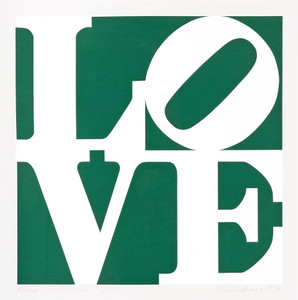

Robert Indiana - AMOR, 1994
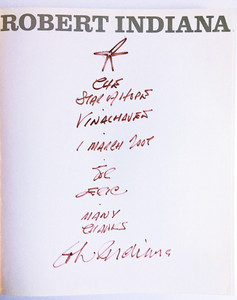
The scarce and coveted piece is pencil-signed, titled AMOR and dated by the artist along the bottom edge. It is numbered 1/50 - the very first example from the small edition of only 50.
In excellent condition; unframed
AMOR
Robert Indiana, American (1928–2018)
Date: 1994
Aquatint & Etching on BFK Rives with deckled edge
signed, titled, numbered and dated in pencil
Edition of 1/50
Sheet Size: 30 x 30 in. (76.2 x 76.2 cm)
Printer: Vinalhaven Press, Maine with blind stamp
Publisher: American Image Editions
This beautiful work is a collectible print titled AMOR (1994), an aquatint etching by the American Pop Art legend Robert Indiana. The artwork features the Spanish word for love, "AMOR," split into two lines with bold red letters against a vibrant blue square, echoing the artist's iconic "LOVE" motif. It was commissioned by the São Paulo Biennial in 1994, produced at Vinalhaven Press (the artist's own press) in Maine, and is part of a limited edition of 50 prints.
ROBERT INDIANA BIOGRAPHY
One of the preeminent figures in American art since the 1960s, Robert Indiana played a central role in the development of assemblage art, hard-edge painting, and Pop art.
Indiana, a self proclaimed “American painter of signs,” created a highly original body of work that explores American identity, personal history, and the power of abstraction and language, establishing an important legacy that resonates in the work of many contemporary artists who make the written word a central element of their oeuvre.
Robert Indiana was born Robert Clark in New Castle, Indiana on September 13, 1928. Adopted as an infant, he spent his childhood moving frequently throughout his namesake state. His artistic talent was evident at an early age, and its recognition by a first grade teacher encouraged his decision to become an artist. In 1942, Indiana moved to Indianapolis in order to attend Arsenal Technical High School, known for its strong arts curriculum. After graduating he spent three years in the U.S. Air Force and then studied at the Art Institute of Chicago, the Skowhegan School of Sculpture and Painting in Maine, and the Edinburgh College of Art in Scotland.
In 1956, two years after moving to New York, Indiana met Ellsworth Kelly, and upon his recommendation took up residence in Coenties Slip, once a major port on the southeast tip of Manhattan. There he joined a community of artists that would come to include Kelly, Agnes Martin, James Rosenquist, and Jack Youngerman. The environment of the Slip had a profound impact on Indiana’s work, and his early paintings include a series of hard-edge double ginkgo leaves inspired by the trees which grew in nearby Jeannette Park. He also incorporated the ginkgo form into his nineteen-foot mural Stavrosis (1958), a crucifixion pieced together from forty-four sheets of paper that he found in his loft. It was upon completion of this work that Indiana adopted the name of his native state as his own.
Indiana, like some of his fellow artists, scavenged the area’s abandoned warehouses for materials, creating sculptural assemblages from old wooden beams, rusted metal wheels, and other remnants of the shipping trade that had thrived in Coenties Slip. While he created hanging works such as Jeanne d’Arc (1960–62) and Wall of China (1960–61), the majority were freestanding constructions which Indiana called “herms” after the sculptures that served as boundary markers at crossroads in ancient Greece and Rome. The discovery of nineteenth-century brass stencils led to the incorporation of brightly colored numbers and short emotionally charged words into these sculptures as well as canvases, and became the basis of his new painterly vocabulary.
-Courtesy PACE Gallery