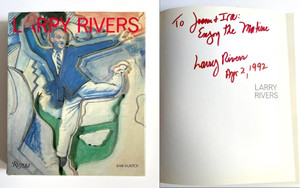
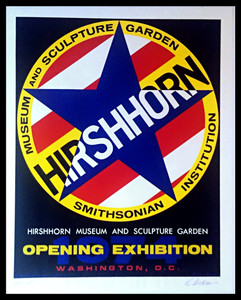
Larry Rivers - Works from the Hirshhorn Museum Collection - hand signed and uniquely inscribed to Al Lerner, the first director of the Hirshhorn Museum, 1981
Larry RiversCONTACT GALLERY FOR PRICE
Larry Rivers - Works from the Hirshhorn Museum Collection - hand signed and uniquely inscribed to Al Lerner, the first director of the Hirshhorn Museum, 1981
Lithograph with offset lettering
Hand signed in graphite by Larry Rivers and inscribed to Al (Abram) Lerner - the Hirshhorn Museum's very first director (more about both Rivers and Lerner below)
Also bears artists printed name, copyright and date (1981)
A rare proof, aside from the regular edition of 400
Unframed
This marvelous hand signed print was published on the occasion of a major 1981 Larry Rivers exhibition at the Hirshhorn. Forty-three works by Rivers, including paintings, sculptures, and mixed-media compositions selected from the Hirshhorn’s permanent collection, were displayed in this exhibition, among them I Like Ingres, Too; Molly and Breakfast; and the massive piece The Russian Revolution.
Larry Rivers Biography (courtesy Guggenheim Museum):
b. 1923, Bronx, New York; d. 2002, New York
Born in August 17, 1923, and raised in the Bronx, Larry Rivers was a painter, sculptor, printmaker, poet, and musician at the crossroads of Abstract Expressionism and Pop art, who bucked prevailing trends in favor of a more singular style. The son of Ukrainian Jewish immigrants, he was known as Yitzroch Loiza (Irving) Grossberg until age 17, when a nightclub emcee announced his band as “Larry Rivers and the Mud Cats.” He adopted the name that same year. Following a brief stint in the U.S. Army, Rivers spent a year at the Juilliard School of Music studying musical theory and composition. He then pursued his only formal artistic training at Hans Hofmann’s painting school in New York from 1947 to 1948. Countering the vogue for abstraction at the time, Hofmann’s approach emphasized drawing as the foundation of all art making and presented the old masters as rich resources for creative exchange. In 1951, Rivers received a BA in art education from New York University.
Proceeding from the conviction that figuration was not antithetical to modernism, Rivers completed his first major work, The Burial, in 1951, signaling the major concerns that he would return to throughout his life. With this painterly restaging of Gustave Courbet’s masterpiece A Burial at Ornans (Un enterrement à Ornans, 1849–50), Rivers began a sustained engagement with canonical paintings, imaginatively connecting contemporary art with art history. In works such as Washington Crossing the Delaware (1953), Rivers similarly mined the past for inspiration; a few years later, he began to take up more contemporary images, as in Dutch Masters and Cigars (1964), which was partly copied from a cigar box that itself depicted Rembrandt’s 1662 painting The Syndics of the Clothmakers’ Guild (De Staalmeesters). Subsequently, Rivers made several works that combine sculpture and painting, including I Like Olympia in Blackface (1970), which reverses the roles of Édouard Manet’s Olympia and her African servant. Later that decade, Rivers began appropriating his own work from the 1950s and 1960s with the series Golden Oldies (1978–79). In an interview with his close friend the poet Frank O’Hara, Rivers illuminated the premises of his approach, saying, “I think of a picture of a smorgasbord of the recognizable.”¹ Two of his largest projects adopted broad historical themes. The History of the Russian Revolution from Marx to Mayakovsky (1965), an enormous mixed-media assemblage, incorporated painted portraits, architectural cutouts, stenciled lettering, and found objects. The monumental History of Matzah: The Story of the Jews (1984–85) also used text and three-dimensional relief elements, this time to narrate Jewish history from Moses to Theodore Herzl, the founder of Zionism.
Rivers’s first major survey was organized by the Rose Art Museum, Brandeis University, Waltham, Massachusetts, in 1965; it traveled to the Pasadena Art Museum; Jewish Museum, New York; Detroit Institute of Arts; and Minneapolis Institute of Arts. A retrospective of his paintings and drawings opened at the Butler Institute of American Art, Youngstown, Ohio, in 1990, and toured the United States for a further two years, with stops in the Norton Gallery of Art, West Palm Beach, Florida; Fort Wayne Museum of Art, Indiana; Scottsdale Center for the Arts, Arizona; and J. B. Speed Art Museum, Louisville, Kentucky. In 1997, the Philharmonic Center for the Arts, Naples, Florida, staged a retrospective of the works Rivers made between 1980 and 1997. His most comprehensive retrospective to date was at the Corcoran Gallery of Art in Washington, D.C., in 2002. Rivers continued painting up until three months before his death in Southampton, New York, on August 14, 2002.
More about Al (Abram) Lerner – the Hirshhorn’s first director
First director of the Hirshhorn Museum and Sculpture Garden, 1974-1984. Lerner was the son of Lower East Side Manhattan immigrants, Hyman Lerner, a garment presser, and Sarah Becker (Lerner), both originally from Russia. While a student at New York University in art history, he gained experience curating the annual student show. After graduation in 1935, Lerner worked as an apprentice muralist for the WPA (Works Progress Administration), part of Roosevelt’s New Deal program which included employment for artists and writers. In 1943 Lerner married Pauline Hanenberg (d. 2003). After World War II, hoping to supplement his painting career, Lerner took an assistant’s job at the A. C. A gallery in 1945 in Manhattan, painting in his spare time. There he met the art collector and uranium magnate/investor Joseph H. Hirshhorn (1899-1981). The two developed a strong friendship. Hirshhorn financed Lerner, who quit A.C.A. and traveled to Florence in 1955 to studying art in hopes of advancing his painting career. He returned to the U.S. and worked again selling art in another gallery, the Artists’ Gallery. Hirshhorn established his own foundation in 1956 and by 1957, Lerner was supervising the research, conservation and installation of the paintings and sculptures for it. The collector continued to acquire art for his 24-acre estate in Greenwich, CT, and Manhattan office, with Lerner, under the title of curator, managing it. Lerner also accompanied the collector on his whirl-wind acquisition jaunts, advising only his headstrong and brusque boss only slightly. Hirshhorn decided to create a public museum for his art, taking Lerner to England where an offer give land had come from Queen Elizabeth. In 1966, S. Dillon Ripley, (1913-2001) secretary of the Smithsonian Institution, organized a lunch with President Lyndon B. Johnson (1908-1973) at the White House, convincing him to build and endow a modernist museum for the nation. Lerner supervised the transfer of the nearly 6,000 paintings and sculptures to the Hirshhorn Museum beginning in 1967. The Museum opened in 1974. Lerner became director of the museum overseeing the installation of newer donations by Hirshhorn. Hirshhorn died in 1981 leaving a $5 million-bequest and the remainder his collection to the museum. Lerner retired in 1984, succeeded by James T. Demetrion, moving to Southampton, NY. He resumed painting in retirement. He died of heart failure in a retirement community at age 94. Lerner owed his position as first director of a major art museum to his long-standing relationship with its founder, similar to the position of David Finley when the National Gallery was first founded. Unlike Finley, however, Lerner took an active role in the installations and shows. At first a Washington outsider, he was accepted by the greater art-administrational community. He wrote no works except those catalogs co-authored by art historians.