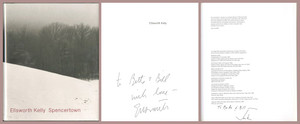
Ellsworth Kelly, Handwritten, signed note on Whitney Museum card to CBS cameraman and collector Dan Pope
Ellsworth KellyCONTACT GALLERY FOR PRICE
Ellsworth Kelly
Handwritten, signed note on Whitney Museum card to CBS cameraman and collector Dan Pope
Ink on offset lithograph card
Handwritten note signed and inscribed to Dan Pope. It reads,
"Dear Dan Pope,
Thanks for your appreciation
Ellsworth Kelly
March 16, 1983"
Dan Pope was a longtime CBS cameraman and art collector who amassed an impressive personal collection of autographs, notes and signed books during the 1980s and 1990s by some of the most renowned visual artists of the era.
This card was sent to Dan Pope by Ellsworth Kelly in response to a flattering letter he wrote to the artist, which included a self-addressed stamped envelope.
The back of the card depict Kelly's 1963 work "Briar", a pencil on paper drawing in the permanent collection of the Whitney Museum
This work has been elegantly float framed with pocket corners and plexiglass windows on the front and the back to reveal both sides of the card with inscription.
Measurements:
Framed
11.5 inches (vertical) by 13 inches (horizontal) by 2 inches
Card with signed note:
4 inches (vertical) by 6 inches (horizontal)
Ellsworth Kelly Biography:
Ellsworth Kelly’s innovations of the late 1940s and early 1950s helped reshape abstract art for decades. His development of the monochrome and the multi-panel painting, his devotion to integral forms, and his use of chance and seriality would prove central to painting’s break with expressionism in the 1960s. But his approach to abstraction was also utterly unique, grounded in particulars rather than universals. His use of found compositions — the fold of a cigarette packet or the contour of a grape leaf — opened a new horizon of possibilities: “Everywhere I looked, everything I saw became something to be made, and it had to be made exactly as it was, with nothing added.”
Over the course of a seven-decade career, Kelly translated these found compositions into paintings, sculptures, drawings, prints, and photographs whose visual power transcended movements. The consistency of his artistic vision ensured that each work was immediately recognizable as his own, even when he experimented with new forms and materials.
Using the same rigor with which he translated his observations of the world (art historian Richard Shiff has called them “fragments of visual experience”), Kelly often returned to his earlier works and sketches. The immediacy of his sensory intuition, combined with his diligent translation of it, enabled him to keep making innovative work throughout his long career. As John Coplans explained in 1969, “since Kelly rarely abandons an idea — his system is incredibly open — he will permit a nascent or embryonic idea to mature without urgency.” This slow gestation helps explain one of contemporary art’s most consistently surprising bodies of work.
Ellsworth Kelly (1923–2015) was born in Newburgh, New York. In 1948 he moved to France, where he came into contact with a wide range of classical and modern art. He returned to New York in 1954 and two years later had his first exhibition at the Betty Parsons Gallery. The Museum of Modern Art in New York organized his first retrospective in 1973. Subsequent exhibitions have been held at museums around the world, including the Solomon R. Guggenheim Museum in New York, the Tate Gallery in London, Haus der Kunst in Munich, and the Centre Pompidou in Paris.
-Courtesy Matthew Marks Gallery