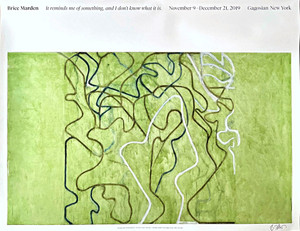
Brice Marden, Vintage 1976 Stedelijk Museum Color Correction print (Hand signed by Brice Marden, from the private collection of Dan Pope, former CBS cameraman and collector), 1984
Brice MardenCONTACT GALLERY FOR PRICE
Brice Marden
Vintage 1976 Stedelijk Museum Color Correction print (Hand signed by Brice Marden, from the private collection of Dan Pope, former CBS cameraman and collector), 1984
Offset lithograph card
Printed by Plane Image, 54 Bond Street NY
Stamped on the verso "edition and colour-correction stedelijk museum amsterdam b. marden 1976"
Hand signed and dated 1984 in black marker by Brice Marden
Provenance: Signed by the artist for Dan Pope, former CBS cameraman and art collector who amassed one of the most significant collections of visual artists' autographs in the 1980s and 1990s
This work has been elegantly float-framed in a dark wood frame under UV plexiglass
Measurements:
Framed
10.75 inches vertical by 9 inches horizontal by 2 inches
Art Card
6 inches vertical by 4 inches horizontal
BRICE MARDEN BIOGRAPHY
Brice Marden (1938–2023) continuously refined and extended the traditions of lyrical abstraction. Experimenting with self-imposed rules, limits, and processes, and drawing inspiration from his extensive travels, Marden brought together the diagrammatic formulations of Minimalism, the immediacy of Abstract Expressionism, and the intuitive gesture of calligraphy in his exploration of gesture, line, and color.
Born in Bronxville, New York, Marden received an MFA from Yale University’s School of Art and Architecture, where his teachers included the painters Alex Katz and Jon Schueler. After graduation he worked as a guard at the Jewish Museum in New York. There, during a 1964 Jasper Johns retrospective, Marden studied Johns’s early works extensively and considered them in relation to the Baroque masters he has long admired, such as Francisco de Zurbarán, Francisco Goya, and Diego Velázquez. Marden’s paintings from the 1960s include subtle, shimmering monochromes in gray tones, sometimes assembled into multipanel works, in a manner similar to the black paintings and White Paintings of Robert Rauschenberg, who hired Marden as a studio assistant in 1966.
A trip to Greece in the early 1970s led Marden to create the Hydra paintings (1972), which capture the turquoise hues of the Mediterranean, and Thira (1979–80), a painting composed of eighteen interconnected panels inspired by the shadows and geometry of ancient temples. To heighten the effect of each color, plane, and brushstroke, Marden developed the unique process of adding beeswax and turpentine to oil paint and applying the mixture in many thin layers. Marden employed this technique for the Grove Group paintings (1972–76)—exhibited at Gagosian’s Madison Avenue gallery in New York in 1991, along with related works—and the Red Yellow Blue paintings (1973–74)—four permutations of the primary trio—which were united for the first time since their making at Gagosian, 980 Madison Avenue, New York, in 2013.
In the 1980s Marden began to incorporate organic, intersecting lines, creating rhythmic patterns over fields of color. Exploring these winding lines, he experimented with blank space, erasure, and references to the natural world. He sought to create a mystical experience through the creation of elusive abstract spaces. As his many themes and techniques have overlapped, Marden brought them together in cohesive, often multipart works, which he has described as his “summation paintings.” Among them is The Propitious Garden of Plane Image, Third Version (2000–06), held in the collection of the Museum of Modern Art in New York, where he had his first comprehensive retrospective in 2006.
In his later years Marden continued his exploration of the qualities of monochrome. This engagement with muted colors informed his calligraphic drawings and works on canvas, such as the Nevis Stele paintings (2007–15), inspired by Chinese stone carvings from the late eighth century. In 2017 he turned his gaze to the expansive possibilities of terre verte (green earth), an iron silicate clay pigment, which he first used in the Grove Group. These paintings incorporate many different brands of terre verte, each a variation on the indefinable hue. Marden thinned his slow-drying paint and applied it gradually to the canvas in many successive layers, leaving a visible residue of the painting process at the lower edge of each canvas.
-Courtesy Gagosian Gallery