


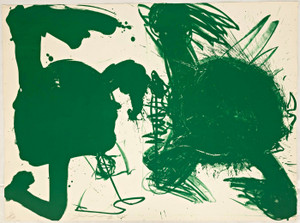

Walasse Ting - Red Thing, from Fortune Kookie VII, 1964
Lithograph (stone) in red on white Arches paper with deckled edges
Signed, dated '64 and annotated Trial and Artist's Proof in red crayon on the front
bears Tamarind blind stamp
A unique Trial/Artists Proof. aside from the regular edition of 20
Published by Tamarind Lithography Workshop
A scarce print; other examples are in the permanent collection of the Museum of Modern Art, the Amon Carter Museum and the National Gallery of Art
unframed
Walasse Ting (1928–2010) was one of the most radical and independent artists of his time. His work fused the traditions of Chinese art with the joy of the Northern European COBRA movement, and combined the electric colors of Pop Art with the kinesthetic power of Abstract Expressionism. Until now, recognition of Ting’s art historical legacy in the West has primarily been limited to his artist’s book, 1¢ Life (1964), a folio conceived by Ting and edited by Sam Francis, which featured work by 27 of Ting’s artist friends, including Roy Lichtenstein, Asger Jorn, Allan Kaprow, Kiki Kogelnik, Joan Mitchell, Robert Rauschenberg, Claes Oldenburg and Andy Warhol.
Walasse Ting was a Chinese-American visual artist and poet, garnering critical praise and a popular following for his colorful works blending Eastern and Western style. Born in 1929 in Wuxi, China, Walasse briefly attended the Shanghai Art Academy, but always considered himself to be self-taught, learning to draw with chalk on the street at a young age.
In 1952, he immigrated to Paris and became associated with the avant-garde group COBRA. In 1958, he settled in New York during the height of the Abstract Expressionist and Pop Art movements. His work began to transition from black and white abstractions reminiscent of Zao Wou-ki, to boldly colored figurative works blending calligraphic brushstrokes with splatters, splashes, and bright fields of color. His widely collected series of female nudes exemplify his embrace of this decidedly Western, vivid coloration. He befriended Sam Francis, who helped publish 1 Cent Life (1964), a book of Walasse”s poetry illustrated by artists, Andy Warhol, and Francis, among others.
Walasse was awarded the Guggenheim Fellowship Award for drawing in 1970. Toward the end of his life, Walasse split his time between New York and Amsterdam. His works can be found in many museum collections including the Metropolitan Museum of Art, the Guggenheim, the Tate Modern, and Centre Pompidou.
Walasse Ting died in 2010 in New York.


