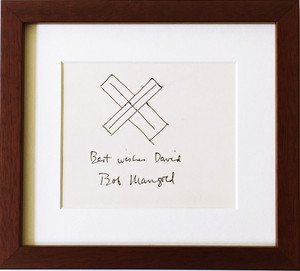
Robert Mangold
Rubber stamp print on custom cut Cambersand paper
Stamp made by Unity Engraving Company, Inc.
Printed by Aaron Arnow
Paper size: 8 x 8 inches (20.3 x 20.3 cm)
Edition of 1000
(Numbered 917 of 1000)
Accompanied by the original colophon envelope
Provenance: Rubber Stamp Portfolio
ROBERT MANGOLD BIOGRAPHY
Robert Mangold has, since the 1950s, explored line and color on supports ranging in shape, size, and dimension.
Committed to abstraction as a means of communication, he has worked within a consistent geometric vocabulary to produce a varied body of paintings and works on paper. His career has developed through an evolution of techniques for the application of paint onto his chosen surface—first plywood and masonite, and later, beginning in 1968, stretched canvas. Moving away from the conventions of paintings, he introduced shaped canvases, working with symmetrical and asymmetrical forms as well as curvilinear edges. For his early shaped and multi-panel constructions, Mangold airbrushed oil-based pigments in gradations of color, and later used a roller before ultimately adopting a brush to apply acrylic in subtle hues that near transparency. He remained intrigued by color as much as structure, and his relationship with it shifted throughout the decades. His initial palette, inspired by industrial objects—file cabinets, brick walls, and trucks—transitioned toward colors that evoke mood: warm ochres, light blues, deep oranges, olive greens, and other hues. Mangold’s mostly monochromatic compositions show an attention to gesture with the addition of hand-drawn pencil lines that curve across the planes of color.
-Courtesy PACE Gallery
Robert Mangold
Robert Mangold is one of the most pre-eminent artists of his generation. Since the 1960s he has developed an artistic vocabulary derived from the idea of geometry and asymmetry in shape and form. Mangold's use of subtle colour and curvilinear abstract forms are associated with Minimalism but also recall other sources from Ancient Greek pottery to Renaissance frescoes.
Robert Storr wrote in 2000: "Figurative artists develop subject matter; abstract artists like Mangold develop ‘object matter’. His basic themes have been the fragment in relation to the whole (how, for example, can a pie slice-shaped painting be read both as a section of an invisible circle and a form complete unto itself?); formal stability in relation to formal abnormality (an exploration begun with the distorted squares and circles of 1969 – 71); the tangible concreteness of painting in relation to the illusionism to which it lends itself (how does a surface assert its materiality while suggesting transparency?); the effect of image-scale upon image-reception (what, for example, distinguishes a model from a work, and how does a small work function in comparison to a larger one of the exact same configuration?); and above all the desire to keep painting whole, with all its elements clearly legible yet fully reconciled with one another." Robert Storr, ‘Betwixt and Between’, Robert Mangold, London: Phaidon, 2000, p. 99
Robert Mangold (born 1937) lives and works in Washingtonville, New York. Since his first one-person exhibition in 1964, Mangold's work has been exhibited extensively worldwide, including solo exhibitions at Solomon R. Guggenheim Museum New York, 1971; Kunsthalle Basel, 1977 and Stedelijk Museum, Amsterdam. His work has been included three times in both Documenta, Kassel (1972, 1977, 1982) and in the Whitney Museum of American Art Biennial (1979, 1983, 1985). Mangold has also been exhibited in the Venice Biennale in 1993.
The first part of Mangold's catalogue raisonné exists in two parts, the first in 1982, and the second in 1998-99. A catalogue raisonné of Mangold's prints was published by Parasol Press, New York in 2000, in addition to 'Robert Mangold', a major monograph published by Phaidon Press in the same year.
-Courtesy Lisson Gallery
-

-
-
-
Sylvia Plimack Mangold, Six Inches Four Ways, in the original colophon envelope, 1976
Sylvia Plimack Mangold
-