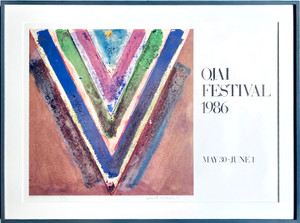
Richard Diebenkorn - Ojai Festival - VIP Deluxe Signed Limited Edition, 1980
Richard Diebenkorn
kr.0.00
Richard Diebenkorn - Ojai Festival - VIP Deluxe Signed Limited Edition, 1980
Lithograph with offset lettering
Boldly signed "R Diebenkorn" and numbered 49 in blue marker with the artist's full, inimitable signature, from the limited edition of 100
This scarce Diebenkorn print was created on the occasion of the Ojai Music Festival in 1980. It bears Diebenkorn's full signature - which makes it more collectible than many of the prints bearing only his initials, and is numbered 49, from the limited edition of only 100. (There was, a separate, unsigned poster edition.) The print features details from one of Diebenkorn's iconic work from 1979. Prints bearing Richard Diebenkorn's full signature are very desirable and elusive, as the artist often signed even the pricier editions (some costing tens of thousands of dollars) with just his A rare opportunity - and a true collectors' item.
RICHARD DIEBENKORN BIOGRAPHY
Richard Diebenkorn (1922–1993) produced, over a forty-five year span, a body of work whose beauty and mysteriously empathic nature has long attracted many devotees worldwide. He lived during the period of America’s great surge onto the world stage of visual art, working alongside the likes of Willem de Kooning, Philip Guston, and Joan Mitchell, but forging a decisively independent style. While still in his twenties he moved briefly to New York from his native San Francisco region, realizing that its artistic climate was the most stimulating locus in the United States, but soon returned to California where, aside from two important early years in Albuquerque, New Mexico, and a year teaching in Urbana, Illinois, he remained.
From a glorious early flowering in the language of Abstract Expressionism, where he responded directly to the light and landscapes of New Mexico and the urban Midwest, Diebenkorn turned to a prolonged period of making figurative and landscape art, going very much against the grain of his generation. A leader in Bay Area figurative painting, Diebenkorn produced work that was received with enormous affection and excitement by a wide audience. Then, quite abruptly in 1966, he turned to a new form of abstraction, again decisively different from his peers. Moving from Berkeley to Los Angeles, he proceeded to make the monumental abstract works known as the “Ocean Park” series, incorporating the lessons of two of his key influences, Henri Matisse and Piet Mondrian.
-

-
-
-
-
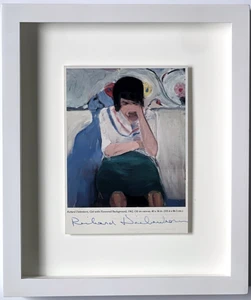
Richard Diebenkorn, Rare Museum Poster, Hand Signed and Inscribed to Dick
kr.0.00Richard Diebenkorn