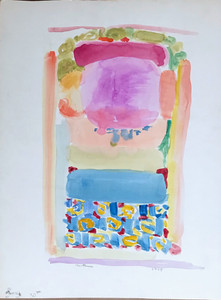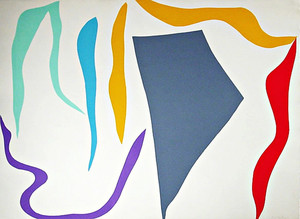

Raymond (Ray) Parker - For Carl, Abstract Expressionist painting, 1972
Ray ParkerCONTACT GALLERY FOR PRICE
For Carl, Abstract Expressionist painting, 1972
This is a poignant acrylic on paper painting from the early 1970s by renowned New York Abstract Expressionist Ray Parker. Inscribed "For Carl" [gallerist Carl Solway], hand signed and dated 1978 top left recto.
Provenance: Carl Solway Gallery, Cincinnati label on the verso, bearing the gallery's unique inventory number for the artwork.
This work has been elegantly floated and framed in a museum quality wood frame under UV plexiglass; with the original Carl Solway label affixed to the verso for provenance.
Measurements:
Framed
26.75 inches (vertical) by 26.75 inches (horizontal)
Artwork
23 inches (vertical) by 22 inches (horizontal)
Raymond (Ray) Parker Biography
Ray Parker was born in 1922 in South Dakota. After completing his MFA at the State University of Iowa, he moved to New York City in 1951. In 1955, he was hired as a Professor of Art at Hunter College, where he would teach until his death in 1990 in New York.
Throughout the 1950s he was included in a number of important group exhibitions organized by major museums, including the Metropolitan Museum of Art, the Museum of Modern Art, and the Whitney Museum of American art. He would go on to exhibit widely across the country at galleries like the Stable Gallery and the Kootz Gallery in New York, as well as the Dwan Gallery and Paul Kantor Gallery in California.
Ray Parker’s “Stroke” paintings in the early 50s developed into the “Simple Paintings” done in the late 50s and early 60s. These consisted of a small number of cloudlike color shapes arranged across an often large canvas. The colors and their relationships to each other are the strength and drive behind these works. Parker worked on these intuitively, almost improvising each painting in turn. Of these works, he said, ‘Those isolated spots of color came to me just by staring at the empty canvas…I spread it out until it came into fullness of volume or a sense of reality, and I stopped there.”
In the 1970s and 80s, Parker moved away from his “Simple Paintings” towards a curvelinear style that allowed freedom of movement. That developed into his line paintings in which he squeezed color directly from the tube. He expanded on these lines with colored grounds, and then back to areas of color with linear elements.
His work is placed in many museum collections including the Whitney Museum of American Art, the Museum of Modern Art, the Solomon R. Guggenheim Museum, and the Museum of Fine Arts, Houston.