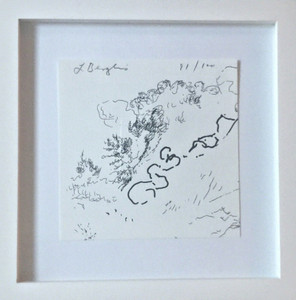
Lynda Benglis, DUAL NATURES (Framed with label from AIDS Project Los Angeles), 1990
CHf0.00
Lynda Benglis
Alpha 137 Gallery and Art Advisory
In business for nearly two decades, we are a well established, popular contemporary art boutique specializing in expertly chosen prints, multiples, and unique sculptures, design objects, works on paper and paintings by recognized artists, with a focus on the secondary market. We also have an impressive selection of scarce and coveted art historical ephemera, monographs and merchandise at different price points. Discover our small business: one of the best kept secrets in the art world, and join our ever-growing family of art lovers - from first time collectors to seasoned fine art professionals. Please note that works are available for purchase exclusively online, and we are not able to accommodate requests for in person viewings at this time.
For a short order art appraisal, please click the "Art Appraisal Services" option above. To reach us, click on the
Contact Us option above or at the bottom of this page.
An educated collector is our best client


Lynda Benglis
Dual Nature (Brown), 1991
Lithograph with gold leaf on tinted paper
Signed, numbered, and dated by Lynda Benglis on the back
Frame Included
Measurements:
Frame:
56.5 x 36.75 inches
Print:
47 x 30 inches
About Lynda Benglis:
Since the 1960s, Lynda Benglis has been celebrated for her free, ecstatic forms, which are simultaneously playful and visceral, organic and, abstract.
Benglis began her career in the midst of the Postminimal movement, pushing the traditions of painting and sculpture into new territories. She initiated several bodies of work in the late 60s and early 70s that set the course for her subsequent practice. Her wax paintings, which began with brushed skin-like layers of pigmented beeswax and dammar resin progressed, in one series, to the use of a blowtorch as a kind of brush, manipulating colors into a marbleized surface that seemingly fought against the constraints of the lozenge-shaped Masonite panels. The impulse to see these forms flow beyond the structure of a traditional support led Benglis to embrace pigmented latex, which she began pouring directly onto the floor. The use of gravity and her body in the latex pours invoked Jackson Pollock’s process, a connection immortalized in the February 27, 1970 edition of Life magazine, which featured Benglis at work.
Concurrently, she began working with pigmented polyurethane foam, building the volume of her sculptures vertically by pouring the oozing, lava-like forms against walls and in the corners of spaces or over constructed armatures and chicken wire, which she removed after the wall mounted foam pours solidified. Benglis’s totem-like sculptures followed as long, cylindrical structures made of wire mesh, cotton bunting, and plaster that, by 1972, she began to tie into knots. Painted with metallic sparkle, Sculp-Metal, or layers of sprayed, vaporized aluminum, copper, zinc, or tin, the works are further complicated by the reflections of their surfaces, conflating the sculptural object with painterly space. The contorted shapes, formed by the artist’s hands, express the bodily force used by Benglis throughout her career continuing with her gold sculptures of the late 1970s and early 1980s.
In the early 70s, Benglis took new media technologies as her material, producing video art at a time when it was still in its early stages as a medium. Her experimental videos feature performative actions and technological mediation to explore themes of physical presence, narcissism, sexuality, and gendered identity. Physical and Psychological Moments in Time, a retrospective of video works by Benglis, was held in 1975 by Fine Arts Center Gallery, State University of New York College at Oneonta, and subsequently traveled to Stedelijk Van Abbemuseum, Eindhoven, Netherlands. Benglis also introduced images of herself into the public discourse through a 1974 Artforum ad, which challenged assumptions about self-presentation and gender in the male-dominated art world.
Benglis extended her innovative use of materials into the natural realm when, in 1984, she first used water as an element in her sculptures. She won the competition to create a fountain for that year’s Louisiana World Exposition in New Orleans, resulting in The Wave of the World (1983–84) in cast bronze. Since then, she created numerous sculptural fountains, including Chimera (1988) and Double Fountain, Mother and Child, For Anand (2007), the latter originally installed at Le Jardin Botanique de Dijon, France, and North South East West (2009), which was initially exhibited at the Irish Museum of Modern Art, Dublin. These works effectively convey fluidity in both physical and thematic forms through the use of water as a medium.
The embrace of flowing forms, color, and sensual surfaces plays a large part in Benglis’s continuous investigation of the proprioceptive, sensory experiences of making and viewing her sculptures. From the complex chromatic harmonies of the wax paintings to the selected use of brilliant Day-Glo pigments or phosphorescence in her latex and foam sculptures, Benglis’s exuberant engagement with color, along with her radical employment of material, sets her apart from the more achromatic focus of her Minimalist and Postminimal contemporaries.
Courtesy of Pace Gallery
Lynda Benglis