Color lithograph on wove paper with deckled edges
This is a color lithograph titled "Windmill Antilles" created in 1980 by American photo-realist pioneer Howard Kanovitz. The piece features a surreal juxtaposition of a rustic house in a landscape viewed through a transparent table surface holding breakfast items like plum jam.
Color lithograph on wove paper with full margins and deckled edge
Pencil signed and numbered 42/125, with publisher's blind stamp
Published by Atelier Ettinger, Inc. New York
(There was, separately, a later second state, published in an edition of 175 by Trans World Arts)
Unframed and in excellent condition
The term "Windmill Antilles" is used by cultural historians and travelers to describe the six Caribbean islands famous for their surviving, historic plantation windmills. Historically, these stone structures were used for crushing sugarcane. While you can find similar sugar mills elsewhere in the region, this specific network of six islands boasts a unique concentration of preserved or restored windmill architecture.
Howard Kanovitz was an American painter and printmaker, dubbed “the father of photorealism” by Barbara Rose.
Howard Kanovitz Biography
Howard Kanovitz was a leader of Photo Realism: a documenter of style and fashion, depicting members of the art scene at openings, or superimposing known critics and curators onto images of board room meetings. In his particular style, he explored the intersections of painting, photography, fiction, and fact.
Kanovitz studied at the Rhode Island School of Design and The Art Studenst League in Woodstock where he worked with Yasuo Kyniyoshi before moving to New York an apprenticing with Franz Kline. As a member of New York’s downtown art scene, Kanovitz painted abstract paintings, which he exhibited at Tenth Street Galleries early in his career. Following his father’s death in 1963, Kanovitz went through family photos, an experience which prompted him to interrogate the relationship between images and perception. At this time, Kanovitz abandoned abstraction in favor of a figurative style and worked arduously in this new direction. These efforts culminated in a 1966 solo exhibition at the Jewish Museum, securing his place as a leader of Photo Realism among artists such as Larry Rivers, Alex Katz, and Chuck Close.
His photo based, representational paintings exhibited at the Jewish Museum show were the first to be called “photo-realist” and shocked many in the art community prompting a symposium which was held at the New York Studio School for “downtown artists” to weigh in on this perennial “hot topic”, newly addressed by one of their own.
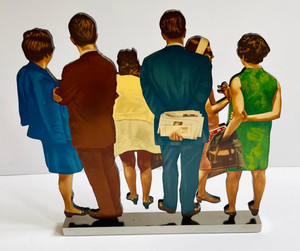
Kanovitz first began using airbrush in 1967, giving his paintings a feeling of photographic perfection. Cut out figures created using this precisionist technique were placed in the viewers space, often in front of Kanovitz’s painted canvas depicting the luminaries of the art world of the time. This type of installation was the centerpiece in the first of several Waddell Gallery shows.
Kanovitz has been the subject of many solo museum shows internationally and his work is collected by institutions such as the Whitney Museum of American Art, Metropolitan Museum of Art, Tate Britain, London, and Museum Moderner Kunst, Vienna.