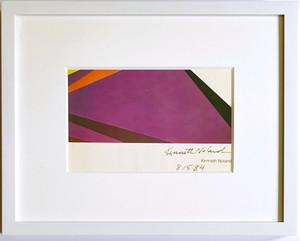
Friedel Dzubas at Andre Emmerich: limited edition Color Field screenprint (Pencil signed and numbered), 1966-1967
Friedel DzubasCONTACT GALLERY FOR PRICE
Friedel Dzubas at Andre Emmerich: limited edition Color Field screenprint (Pencil signed and numbered), 1966-1967
Color silkscreen on wove paper
Rarely seen, this historic pencil signed and numbered (42/100) silkscreen was published in 1966 by the André Emmerich Gallery in New York on the occasion of an exhibition held from December 31, 1966, to January 19, 1967. Andre Emmerich, was, at the time the gallery of record for major color field and Ab Ex artists. (Emmerich would later sell his eponymous gallery to Sotheby's.) This is the scarce hand signed silkscreen (VIP Deluxe) edition of only 100; there was, separately, a more common unsigned folded invitation that was mailed out.
FRIEDEL DZUBAS BIOGRAPHY
In a vibrant career spanning five decades, German-born American painter Friedel Dzubas (1915–1994) created an extensive body of work featuring exquisitely counterpoised brushed color shapes. Early on, Dzubas was associated with a group of second-generation abstract painters who in the later 1950s had turned from broad gestural strokes of thickened impasto in overlapping abstract formations to floating or merging shapes and planes made with thinned pigment that allowed color to become the primary expressive element. Yet, unlike several painter colleagues who stained their diluted pigments into raw canvas, Dzubas activated his surfaces with juxtaposed and crossing forms that felt embodied, full, and which seemed to stand up on the surface, because painted over gesso grounds. It was not until the middle 1960s that Dzubas began to use acrylic paint—a full decade after others had turned to synthetic colors. But for a small series of paintings on bedsheets in 1957–58 and a group of “black drawings” using oil paint created between 1959 and 1962, Dzubas never sought the effect of pigment melding with raw cotton duck even as he continued the “field” painting of Rothko and Newman, applying paint over his grounds in a thin, texturally uniform manner. His later work can be characterized by an effect he called “washing out,” a feathering technique that propels his color forms across the extraordinary lateral expanses of canvases extending from eighteen to twenty-three feet. His magnum opus, Crossing, Apocalypsis cum Figuras, 1975, expands to nearly sixty feet. Working in a large scale allowed Dzubas to realize his equally large vision for color abstraction.
Dzubas was an autodidact, never having undergone formal training in painting. Considered a Mischling (a child of mixed-race parents, a Jewish father and a Catholic mother) and thus denied the opportunity to go to university, at the age of fifteen he was apprenticed to a wall decorations firm in Berlin. Nazi hegemony also constrained his exposure to historic and contemporary artwork until his emigration to America in 1939. For several years after his arrival in America, Dzubas carried on the work of his German uncles and cousins by engaging in free-lance book design, first in Chicago and then in New York. By the late 1950s, he was able to paint full-time.