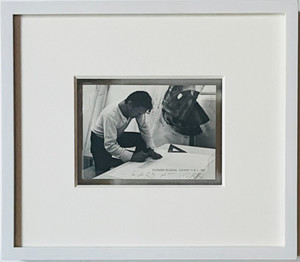
Edward Ruscha at the Texas Gallery vintage invitation, mailed and postmarked to Dennis Hopper, from the Estate of Dennis Hopper, 1974
Ed RuschaCONTACT GALLERY FOR PRICE
Edward Ruscha at the Texas Gallery vintage invitation, mailed and postmarked to Dennis Hopper, from the Estate of Dennis Hopper, 1974
Offset lithograph invitation card (stamped and postmarked), addressed to Dennis Hopper
This rare exhibition invitation for Ed (Edward) Ruscha's 1974 exhibition at Texas Gallery, Houston, which Ruscha, himself, designed, was mailed to actor, photographer, collector and longtime Ruscha supporter Dennis Hopper at his Taos, New Mexico address. Hopper and Ruscha first became acquainted through the Los Angeles art scene of the early 1960s and remained friends for decades. Hopper was an early collector of Ruscha's work, purchasing a painting from Ruscha's 1964 Ferus Gallery exhibition, and was closely associated with the circle of California artists surrounding Ruscha. (Hopper also photographed Ruscha repeatedly during the 1960s and their artistic circle included Billy Al Bengston, Edward Kienholz, Larry Bell and others.).
Dennis Hopper's Taos address on this card is also a nice detail: by the mid-1970s, Hopper was spending significant time in New Mexico, which later became one of the places most closely associated with him personally.
Another nice touch on this card is that is actually postmarked in May, 1974 in Texas, and bears a Robert Indiana 8 Cent LOVE stamp.
What's interesting is that this Ed Ruscha show in the Texas Gallery ran concurrently with a William Wegman exhibition. (Wegman also lived in Los Angeles at the time and was introduced to the gallery by Ruscha.) The Texas Gallery’s first location on Bissonnet Street featured a large awning with the gallery’s name emblazoned in a typeface taken from a Waylon Jennings album cover. It was Ruscha, in fact, who suggested the name "Texas Gallery". And it was Ruscha and Wegman who suggested using two cards featuring the same image of the gallery – one upright and one flipped — to announce their concurrent shows: the present Ruscha invitation is rightside up; the Wegman invite (not included here) was reversed.
The rise of the state of Texas as an important art center in the 1970s is linked to John and Dominique de Menil, the voracious collectors who were also responsible for high profile Houston projects like the Rothko Chapel, and their own museum The Menil Collection. Fredericka Hunter, the force behind Texas Gallery, studied art history with Dominque de Menil, and later became a partner in the Houston prints gallery Contact Graphics, which soon would became Texas Gallery -so the Menil connection was a throughline in the gallery's history. (Sadly, in February 2026, Texas Gallery shuttered after a 50-year run.)
What makes the history of Texas Gallery memorable is not just its impressive roster of New York and California artists, but also its eye-catching promotional materials. For Fredericka Hunter and her gallery partner Ian Glennie creating unusual announcement cards and posters was a way of attracting attention, and of having fun. Often the artists themselves -like Ed Ruscha - participated in the creation of this ephemera, as he did with the present invitation.
This work was acquired directly from the Estate of Dennis Hopper. It is elegantly floated in plastic pocket corners under double sided plexiglass to reveal the entire front of the invitation, as well as the back stamped and addressed to Dennis Hopper. Both sides are postmarked.
Measurements:
Framed
11.25 inches (vertical) by 12.5 inches (horizontal) by 2 inches
Invitation card:
4 inches (vertical) by 5.5 inches (horizontal)
ED RUSCHA BIOGRAPHY:
Ed Ruscha was born in 1937 in Omaha, Nebraska, and grew up in Oklahoma City. In 1956, he took Route 66 to California, which would become a central part of his story as an artist. Settling in Los Angeles, he studied art at Chouinard Art Institute (now California Institute of the Arts) and had an early job as a commercial illustrator. In the 1960s, inspired by artists like Raymond Hains, René Magritte, Jasper Johns, and Kurt Schwitters, Ruscha became a vibrant part of the art scene surrounding Ferus Gallery in Los Angeles.
Paramount to Ruscha’s work is that the changing nature of language —as its meaning shifts as a function of font, color, composition, and other visual effects—can be a subject for painting and drawing. He often repeats the same phrase or word in artworks over the course of many years. Often, his words and phrases have a vernacular, familiar tone, but an unfamiliar reference. Along the way, Ruscha teases out and accumulates new meanings from the expression. Though words typically take a secondary role in the history of art, Ruscha places language at the center of his practice, reflecting on contemporary life, especially in Los Angeles, with candor and humor.
Ruscha’s interest in language is frequently coupled with an interest in landscape, especially that of the American west. His words appear on road signs, buildings, and mountains, and across open skies and horizons. At times, words are strangely present through their disappearance. In early photographic work, Ruscha created documentary images and books full of swimming pools, parking lots, buildings on Sunset Boulevard, gas stations, and many other features of L.A. life. In his paintings and drawings, these same subjects combine with language to poetically evoke the changing fabric of the city through themes of evolution and destruction.
Ruscha has been living and working in the L.A. area for over sixty years. Through his innovative approach to painting, drawing, and photography, Ruscha has influenced artists worldwide and is considered to be one of the most important figures in contemporary art today.