Christo
Wrapped Reichstag - Project for Berlin (Hand Signed), 1984
Offset Lithograph on thick wove paper. Hand Signed. Unframed.
31 3/4 × 27 1/8 in
80.6 × 68.9 cm
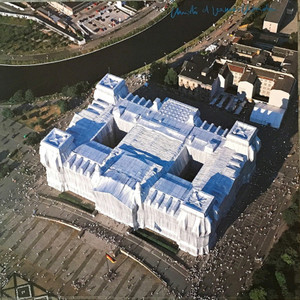
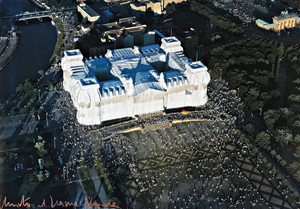
This is a hand signed offset lithograph poster depicting a collage featuring Christo's iconic Wrapped Reichstag which is in the collection at the Berlin Museum. Even though it's a poster, it was printed by Nouvelles Images SA Editeurs in France on lithographic paper, rather than smooth wove paper, so it has the feel of a lithograph. It is, exceptionally hand signed by Christo and is especially uncommon when signed. The project to wrap the German Parliament building was conceived by Christo and his wife Jeanne-Claude in the early 1970s, but was not realized until the 1990s. The structure was wrapped in polypropylene fabric, with 17,060 yards of bright blue rope holding it tight against the 220 tons of steel structure to which the wrapping was attached. A New York Times feature on the project described it as follows: "Wrapped Reichstag, by Christo and his wife, Jeanne-Claude, is at once a work of art, a cultural event, a political happening and an ambitious piece of business. It has got Berlin into more of a celebratory mood than anything since the fall of the wall .... and as the immense project of wrapping the 101-year-old German Parliament building in more than a million square feet of aluminum-colored fabric nears its completion, crowds gather day and night to gawk, to cheer as sections of cloth are unfurled, and to watch for glimpses of the New York artist couple who are treated here like rock stars." Paul Goldberger, who wrote the Times feature, describes the cultural, as well as aesthetic impact of wrapping the Reichstag at that moment in history. "This immense stone hulk, a heavy, bombastic building that epitomizes German excesses of the late 19th century, is rendered light, almost delicate. It takes on an ethereal beauty, and looks as if it could float away into the silvery, cloudy Berlin sky."
In later interviews, Christo would comment on how his work was not considered art at the time - so the New York Times dispatched Paul Goldberger, their architectural critic, not their art critic, to review the project.
In later interviews, Christo would comment on how his work was not considered art at the time - so the New York Times dispatched Paul Goldberger, their architectural critic, not their art critic, to review the project.
-

-
-
-
Christo and Jeanne-Claude, WRAPPED REICHSTAG (PROJECT FOR BERLIN) - SIGNED, 1994
BRL0.00Christo (Christo and Jeanne Claude)
-
Christo, Wrapped Reichstag, Berlin (Hand Signed and Framed), ca. 1995
Christo (Christo and Jeanne Claude)