

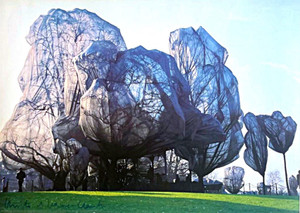
Christo, Art Card: Christo and Jeanne-Claude on the Reichstag Roof (Hand Signed by Christo and Jeanne-Claude), 1993
Christo (Christo and Jeanne Claude)
Alpha 137 Gallery and Art Advisory
In business for nearly two decades, we are a well established, popular contemporary art boutique specializing in expertly chosen prints, multiples, and unique sculptures, design objects, works on paper and paintings by recognized artists, with a focus on the secondary market. We also have an impressive selection of scarce and coveted art historical ephemera, monographs and merchandise at different price points. Discover our small business: one of the best kept secrets in the art world, and join our ever-growing family of art lovers - from first time collectors to seasoned fine art professionals. Please note that works are available for purchase exclusively online, and we are not able to accommodate requests for in person viewings at this time.
For a short order art appraisal, please click the "Art Appraisal Services" option above. To reach us, click on the
Contact Us option above or at the bottom of this page.
An educated collector is our best client


Christo and Jeanne-Claude
Art Card: Wrapped Magazines with Marilyn Monroe (Revues Empaquetees), 1962, (Hand Signed by Christo), 1991
Offset lithograph postcard (hand signed by Christo)
Scarce vintage postcard of Christo's 1962 work "Wrapped Magazines" published on the occasion of The Pop Art Show at the Royal Academy of Arts, London, 13 September-15 December 1991. This card was hand signed by Christo on the image, and gifted to Jeanne-Claude's assistant and book collaborator. The postcard itself is of an unknown edition, but it is, exceptionally hand signed by Christo.
This work has been elegantly floated and framed in a museum quality white wood frame under UV plexiglass.
Measurements
Framed
11 inches (vertical) by 9 inches (horizontal) by 1.5
Signed Card
6 inches (vertical) by 4 inches (horizontal)
Makes a fantastic gift!
Christo Biography
Christo Javacheff and Jeanne-Claude de Guillebon were both born in 1935, he in Gabrova, Bulgaria, and she in Casablanca, Morocco. (They would drop their surnames early on.) Christo studied at the Fine Arts Academy in Sofia (1953–56) before defecting to the West, via Prague, in 1957. That year, he spent one semester at the Akademie der Bildenden Künste in Vienna. He moved to Paris in 1958 and met Jeanne-Claude, who had earned her baccalaureate in Latin and philosophy from the University of Tunis in 1952. They would later marry.
Indebted to Vladimir Tatlin's Constructivist edict "real materials in real space," Christo's first artworks, dating from 1958, consist of appropriated everyday objects such as bottles, cans, furniture, and oil drums wrapped in canvas, bundled in twine, and occasionally overlaid with automobile paint. His first solo exhibition, at Galerie Haro Lauhus in Cologne in June 1961, included his inaugural collaboration with Jeanne-Claude (though she would not publicly acknowledge her role in their creations until 1994), Dockside Packages, a collection of draped oil barrels and rolls of industrial paper arranged outside the gallery along a dock. That same year, the couple made their first attempt at exploring their aesthetic vocabulary on a monumental scale with Project for a Wrapped Public Building, in which they proposed shrouding an unspecified parliamentary edifice, the quintessential symbol of public architecture, in fabric tied down with metal cables. Never realized, the project exists in the form of a photographic collage with an explanatory text by the artists.
Throughout the 1960s, Christo and Jeanne-Claude outlined proposals for similar projects, often involving iconic buildings, like the École Militaire station of the Paris Métro (1961). They saw their dreams come to fruition in the summer of 1968, when they received permission to carry out three of their undertakings: Wrapped Fountain, Piazza Mercato, Spoleto, Italy, 1968; Wrapped Medieval Tower, Spoleto, Italy, 1968; and Wrapped Kunsthalle, Bern, Switzerland, 1968. The following year, they cloaked both the Museum of Contemporary Art in Chicago and a mile-long section of the Australian coastline at Little Bay, north of Sydney. Covered with vast quantities of light-colored fabric, battened down using elaborate systems of cables, ropes, and knots, these architectural and natural forms were defamiliarized, transformed into ghostly presences that momentarily disrupted their surroundings.
Beginning in 1970, the artists executed numerous other projects, all of which became icons of environmental art: Valley Curtain, Grand Hogback, Rifle, Colorado, 1970–72, a curtain of orange nylon suspended across a valley; Running Fence, Sonoma and Marin Counties, California, 1972–76, more than twenty-four miles of white nylon fabric snaking across the countryside; Surrounded Islands, Biscayne Bay, Greater Miami, Florida, 1980–83, around six and a half million square feet of bright pink fabric floating around eleven islands; The Pont Neuf Wrapped, Paris, 1975–85, honey-hued fabric shrouding the city’s oldest bridge; The Umbrellas, Japan–USA, 1984–91, a scattering of 3,100 blue and yellow umbrellas in the valleys around Ibaraki prefecture, Japan, and Tejon Pass, California; Wrapped Reichstag, Berlin, 1971–95, the celebrated German government building swathed in silver fabric; and The Gates, Central Park, New York City, 1979–2005, more than 7,500 metal frames fitted with saffron fabric panels and arranged along some twenty-three miles of walkway in Central Park. Due to the staggering cost and increasing complexity of these ventures, in terms of technical know-how as well as the administrative and environmental hurdles the artists were obligated to surmount, realization often took years, even decades. Unrealized projects, still considered ongoing, include The Mastaba, a plan for a monumental edifice of stacked oil barrels intended for a desert location in the United Arab Emirates, and Over the River, which would feature intermittent extensive canopies of fabric suspended above a 5.9-mile stretch of the Arkansas River.
In his solo work, Christo continues to conceive projects, some existing on paper only, in which found objects—from magazines, newspapers, and street signs, to nude female models, telephones, computers, and automobiles—are wrapped in fabric or plastic and then twined. These assemblages embody many of the themes Christo and Jeanne-Claude explored in their artistic partnership, among them the opposition between the familiar and the uncanny, the veiled and the exposed, the built and the natural environments, utility and futility, permanence and ephemerality.
Major exhibitions of the artists' work have been organized by the Institute of Contemporary Art in Boston (1979), Museum Ludwig in Cologne (1981), Hiroshima City Museum of Contemporary Art (1990), Martin-Gropius-Bau in Berlin (2001), and the Metropolitan Museum of Art in New York (2004). Jeanne-Claude died in 2009; Christo lives and works in New York City.
-Courtesy Guggenheim
Christo (Christo and Jeanne Claude)
Christo (Christo and Jeanne Claude)

Christo (Christo and Jeanne Claude)

Christo (Christo and Jeanne Claude)

Christo (Christo and Jeanne Claude)