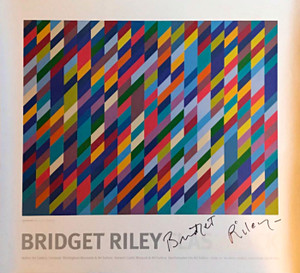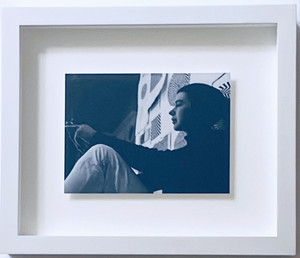
Bridget Riley, Photograph: Bridget Riley 25 May 1969 (Hand Signed by Bridget Riley), ca. 1987
Bridget Riley
£0.00
Bridget Riley
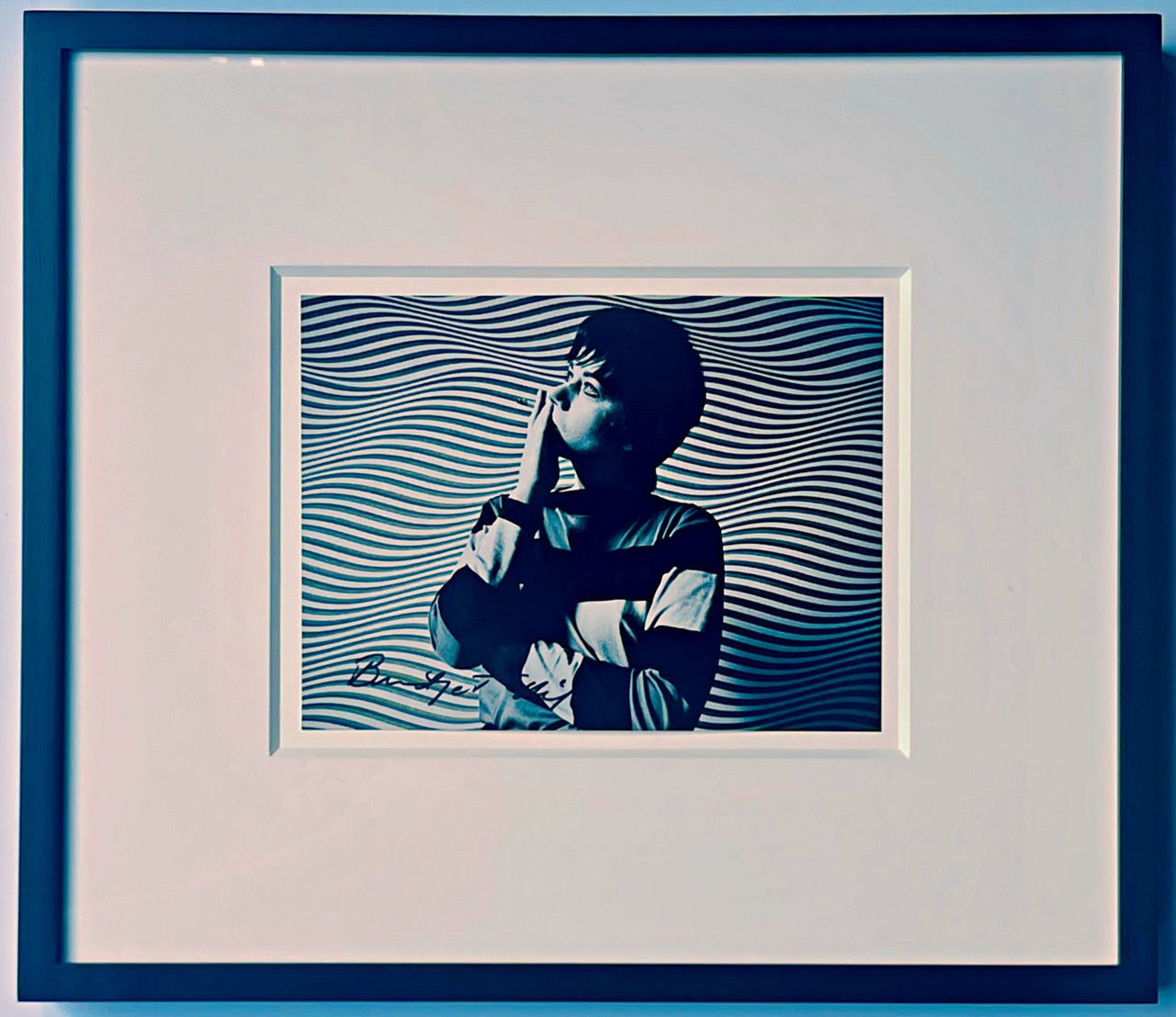
Photograph: Bridget Riley 25 May 1969 (Hand Signed by Bridget Riley), ca. 1987
A rare collectible when hand signed by Bridget Riley
Framed and ready to hang. Makes a superb gift.
Black and white photograph of Bridget Riley smoking in front of one of her iconic Op Art paintings
Uniquely hand signed by Bridget RIley on the front
Original caption: “Bridget Riley: doesn’t handle the paint.” Photograph: David Newell-Smith/The Observer
Observer picture archivePhotography
Observer picture archive: Bridget Riley, 25 May 1969
David Newell-Smith captured the artist in her London studio, ahead of a national tour of her drawings
The 1969 Observer article that accompanies this photograph breathlessly states,
"...Bridget Riley has powder-blue eyes and thin bones. Only in her thirties, she is firmly in the super tax bracket of the international art hierarchy, along with elderly figures like Henry Moore, Chagall and Ben Nicholson. Nowadays, every American or European museum worth its art collection needs a Bridget Riley “op” (“op” is short for optical) painting, just as the National Gallery needs Ducios and Botticellis. And they’re not cheap:"
Provenance: Private collection, Europe
This work has been elegantly framed in a museum quality bold blue wood frame under UV plexiglass
Measurements:
Framed
13 inches (vertical) by 15 inches (horizontal) by 1.5 inches
Photograph:
6 inches (vertical) x 8 inches (horizontal)
BRIDGET RILEY BIOGRAPHY
Since 1961, Bridget Riley (b. 1931) has focused exclusively on seemingly simple geometric forms, such as lines, circles, curves, and squares, arrayed across a surface—whether a canvas, a wall, or paper—according to an internal logic. The resulting compositions actively engage the viewer, at times triggering sensations of vibration and movement. This sense of dynamism was explored to great effect in the artist's earliest black-and-white paintings, which established the basis of her enduring formal vocabulary. In 1967, Riley introduced color into her work, thus expanding the perceptual and optical possibilities of her compositions.
Riley was born in London, where she attended Goldsmiths College from 1949 to 1952 and the Royal College of Art from 1952 to 1955.
Riley’s first solo exhibitions were held at Gallery One, London, in 1962 and 1963, followed by two exhibitions at Robert Fraser Gallery, London, in 1966 and 1967. She was also at that time included in numerous group exhibitions such as Towards Art?, Royal College of Art London (1962); The New Generation, Whitechapel Gallery, London (1964); and Painting and Sculpture of a Decade 1954–1964, Tate Gallery, London (1964). In 1965, her work was included in the now-seminal group exhibition The Responsive Eye, organized by William Seitz at The Museum of Modern Art, New York. In 1968, she represented Great Britain at the 34th Venice Biennale (along with Philip King), where she was the first living British painter to win the prestigious International Prize for Painting. Her first retrospective, covering the period from 1961 to 1970, opened at the Kunstverein Hannover in 1971 and subsequently traveled to Kunsthalle Bern; Kunsthalle Düsseldorf; Galleria Civica d’Arte Moderna, Turin; and the Hayward Gallery, London.
More recent significant solo presentations include those at Dia Center for the Arts, New York (2000-2001); Museum Haus Esters and Kaiser Wilhelm Museum, Krefeld, Germany (2002); Museum of Contemporary Art, Sydney (2004-2005); Musée d'Art Moderne de la Ville de Paris (2008); Walker Art Gallery, Liverpool (traveled to Birmingham Museums and Art Gallery; Norwich Castle Museum and Art Gallery; Southampton City Art Gallery; 2009-2010); National Gallery, London (2010-2011); Art Institute of Chicago (2014-2015); The Courtauld Gallery, London (2015); De La Warr Pavilion, Bexhill on Sea, England (traveled to Gemeentemuseum, The Hague; 2015); Graves Gallery, Museum Sheffield, England (2016); Christchurch Art Gallery, New Zealand (2017); and the Kawamura Memorial DIC Museum of Art, Sakura, Japan (2018).
Bridget Riley: Perceptual Abstraction was on view at the Yale Center for British Art, New Haven, Connecticut, in 2022. The traveling exhibition Bridget Riley Drawings: From the Artist’s Studio, which included drawings from the late 1940s to the present day, originated at the Art Institute of Chicago and was subsequently on view at the Hammer Museum, Los Angeles, and the Morgan Library, New York, in 2023. A solo exhibition of Riley’s work, Point de départ, is currently on display at the Musée d’Orsay, Paris, through January 2026.
A large-scale wall painting by Riley entitled Messengers was unveiled in 2019 at the National Gallery in London. Also in 2019, a solo presentation of the artist’s work that was organized by the National Galleries of Scotland opened at the Scottish National Gallery, Edinburgh, and traveled to the Hayward Gallery, London (2019-2020).
In 1974, Riley was named a CBE (Commander of the Most Excellent Order of the British Empire) and in 1999, appointed the Companion of Honour. In 2003, the artist was awarded the Praemium Imperiale in Tokyo. She received the Kaiser Ring of the City of Goslar, Germany, in 2009 and the Rubens Prize of the City of Siegen, Germany, in 2012.
David Zwirner has worked with Riley since 2014, and the gallery's inaugural exhibition of her work, Bridget Riley: The Stripe Paintings 1961-2014, was held in London that year. In 2015, a career spanning survey was presented at the gallery in New York, and in 2018, the London gallery presented Riley’s recent works from the last four years. Also on view at the gallery’s London location were Bridget Riley – Studies: 1984-1997 in 2020 and Bridget Riley: Past into Present in 2021. Riley lives and works in London, Cornwall, and France.
Work by the artist is included in museum and public collections worldwide, including Art Institute of Chicago; Arts Council, United Kingdom; British Council, United Kingdom; Buffalo AKG Art Museum, New York; Dallas Museum of Art; Dia Art Foundation, New York; Israel Museum, Jerusalem; Kunstmuseum Bern; Los Angeles County Museum of Art; The Metropolitan Museum of Art, New York; Moderna Museet, Stockholm; Museum für Gegenwartskunst, Siegen, Germany; Museum of Contemporary Art, Los Angeles; The Museum of Modern Art, New York; National Museum of Modern Art, Tokyo; Nationalgalerie, Berlin; Stedelijk Museum, Amsterdam; and Tate, United Kingdom.
-Courtesy David Zwirner