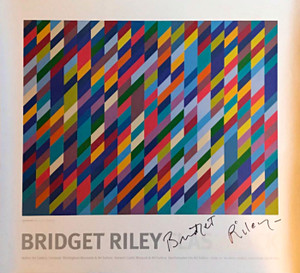
Bridget Riley - broadside of "Final Study for Halcyon", 1972 (Hand signed by Bridget Riley), 1988
Bridget RileyCONTACT GALLERY FOR PRICE
Bridget Riley - broadside of "Final Study for Halcyon", 1972 (Hand signed by Bridget Riley), 1988
Magazine page on paper (Hand Signed by Bridget Riley)
Broadside of Final Study for Halcyon, 1972 (Hand signed by Bridget Riley)
This print was acquired from a private collection in Europe
It is a tear sheet from a catalogue or magazine, depicting Bridget Riley's iconic 1972 work, which she autographed by hand for the previous owner ca. 1988
The work this depicts was in the artist's personal collection, and later exhibited in the 2023 exhibition "Bridget Riley: Drawings from the Artist's Studio" at the Morgan Library in New York. In a contemporaneous review, art critic Saul Ostrow wrote, of this very work:
..."Final Study for “Halcyon” (1971-2), with its pattern of tapering stripes, also have an affinity with some of the Washington Color School painters such as Thomas Downing, Gene Davis, and Kenneth Noland, among others, who also employed vibrant colors and simple geometric forms such as stripes and circles and patterns. The bridge between all these differing trends at the time was systemic art, a practice that emerged in the 1960s and focused on non-intuitive approaches to composition. Though stylistically varied, these artists made serial paintings based on repetition and variation, amongst them were Frank Stella, Ellsworth Kelly, Robert Mangold, Agnes Martin, Kenneth Noland, and Robert Ryman, who, similar to Riley, employed rules dictated by logic and formal concerns. In summing up this trend, Alloway again played a significant role in its definition and promotion: in 1966 he curated the exhibition Systemic Painting at the Guggenheim Museum. Though no longer referenced because it has become a norm, this practice at the time played an important role in the formulation of Minimalism and Conceptual art.
Another context for Riley’s interest in optical effects and visual perception is the historical one of artists such as Giacomo Balla, Stanton MacDonald-Wright, and Robert and Sonia Delaunay, and such movements as Futurism, Synchronism, Vorticism, and Orphism, whose experiments with color and dynamic compositions advanced abstract painting. Futurism and Vorticism are of particular importance because fifty years later Riley would also employ fragmented forms, intersecting lines, and vibrantly colored patterns to convey a sense of motion and energy. By placing Riley’s work within these diverse contexts, the exhibition extends beyond its association with Op art and invites us to critically appreciate the interconnectedness of the evolution of artistic practices, which forms a continuum across different periods."
This print has been elegantly framed in a museum quality wood frame under UV plexiglass
Measurements:
Framed
15.25 inches (vertical) by 14.25 inches (horizontal) by 2 inches
Artwork:
8.25 inches (vertical) by 7.25 inches (horizontal)