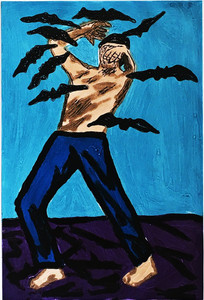
Art Card: Willem de Kooning and Elaine de Kooning, 1953 (Hand Signed by BOTH Willem de Kooning and Elaine de Kooning) from the Dan Pope collection, 1985
Willem de Kooning and Elaine de Kooning
Alpha 137 Gallery and Art Advisory
In business for nearly two decades, we are a well established, popular contemporary art boutique specializing in expertly chosen prints, multiples, and unique sculptures, design objects, works on paper and paintings by recognized artists, with a focus on the secondary market. We also have an impressive selection of scarce and coveted art historical ephemera, monographs and merchandise at different price points. Discover our small business: one of the best kept secrets in the art world, and join our ever-growing family of art lovers - from first time collectors to seasoned fine art professionals. Please note that works are available for purchase exclusively online, and we are not able to accommodate requests for in person viewings at this time.
For a short order art appraisal, please click the "Art Appraisal Services" option above. To reach us, click on the
Contact Us option above or at the bottom of this page.
An educated collector is our best client


CONTACT GALLERY FOR PRICE
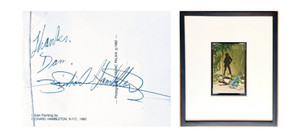
Art Card: Richard Estes - Food Shop, 1970, from CBS' Dan Pope Collection, 1985
Offset lithograph postcard
Boldly signed in black marker by Richard Estes on the front
This card depicts Estes famous 1970 oil on canvas painting "Food Shop", that had been in the collection of Neue Galerie der Stadt Aachen, Ludwig Collection
It was signed by Richard Estes for the previous owner in the mid 1980s
Provenance: Collection of Dan Pope
Dan Pope was a longtime CBS cameraman and art collector who amassed an impressive personal collection of autographed cards, notes and signed books during the 1980s and 1990s by some of the most renowned visual artists of the era.
This work has been float framed in a museum quality wood frame under UV plexiglass.
Measurements:
Framed
10.5 inches (vertical) by 9 inches (horizontal) by 2 inches
Card
6 inches (vertical) by 4 inches (horizontal)
RICHARD ESTES BIOGRAPHY
Richard Estes was born on May 14, 1932, in Kewanee, Illinois. He began painting in high school, but planned to study architecture under Ludwig Mies van der Rohe at the Illinois Institute of Technology, Chicago. However, an influential first trip to Europe prevented Estes from applying for admission in time. He opted instead to begin his studies at the Art Institute of Chicago where he received a BFA in 1956. After graduation he lived and worked intermittently in New York as freelance graphic designer for various publishing and advertising agencies and painted in his spare time. Estes moved back to Chicago for a brief period and by 1959 had gained enough financial stability to move back to New York definitively. He continued to work as a designer and had also begun photographing the city and using these images as departure points for his paintings. In 1966, he finally left his job in advertising and committed to painting full time.
Estes is considered one of the founding Photorealists, a group of artists who used photo-based techniques to achieve hyperrealist effects in their paintings. Estes’s paintings extend beyond a mere translation of photographic verisimilitude, however; his images of urban landscapes—usually of New York, though he also painted images of Venice; Florence, Italy; Barcelona; Cordova, Spain; and Hiroshima—transform the light and forms captured in his photographs into a painting of allover focus and extreme precision. The exaggerated focus and luminosity of his canvases draw closer attention to previously unseen or overlooked aspects of the urban environment, encouraging viewers to interrogate the relationship between reality and vision. Unlike many of his Photorealist contemporaries, Estes did not work from projected slides and never intended his paintings to be literal translations of his images. Despite the exactitude and tightly controlled appearance of his compositions, evidence of brushstroke and scenes of depopulated New York streets point to the artist’s creative modifications of his photographs. The majority of his cityscapes are also devoid of people and narrative potential. Estes generally prefers depicting familiar urban fixtures—modest shop windows, signage, cars, telephone booths, and intersections—to iconic landmarks, although an early work from 1966 depicts a reflection of the Flatiron building, and he later painted an image of Frank Lloyd Wright’s Guggenheim Museum building in 1979.
Estes’s interest in representing light on transparent reflective surfaces began after he saw an exhibition of Lee Friedlander’s photographic urban landscapes in 1967. He received his first solo exhibition in 1968 at the Allan Stone Gallery, New York, where he had five solo exhibitions through the early 1980s. Beginning in the mid-1970s, Estes’s urban vistas took on a new level of complexity through his use of multiple photographs to reconstruct a scene. Although Estes is a primarily a painter of urban landscape, he gradually turned to other terrains, such as Machu Picchu and the coastline of Maine, as well as portraits, most notably of the Chinese American architect I. M. Pei and the French writer Marguerite Yourcenar, in the 1980s and 1990s.
Since Estes’s artistic debut in 1968, he has received many solo exhibitions in the United States and abroad, including those at the Museum of Contemporary Art, Chicago (1974); Museum of Fine Arts, Boston, which traveled to the Toledo Museum of Art, Ohio; Nelson Atkins Museum of Art, Kansas City; Hirshhorn Museum and Sculpture Garden, Washington, D.C. (1978); Isetan Museum of Art, Tokyo, which traveled to Kinetsu Museum of Art, Osaka, Japan, and the Hiroshima City Museum of Contemporary Art (1990); an exhibition of his printed oeuvre and Japan paintings at the Sert Gallery, Carpenter Center for the Visual Arts, Harvard University, Cambridge, Massachusetts (1990); FIAC Foire internationale d’art contemporain, Grand Palais, Paris, with Marlborough Gallery, New York (1993); and Palazzo Magnani, Reggio Emilia, Italy, which traveled to Museo Thyssen-Bornemisza, Madrid (2007). His work has been included in many pivotal exhibitions central to the history of Photorealism, such as those at the Vassar College Art Gallery, Poughkeepsie, New York (1968); Whitney Museum of American Art, New York (1972); Documenta, Kassel, West Germany (1972); Galleria civica di arte moderna, Turin, Italy (1974); Centre national d’art contemporain, Paris (1974); Kunsthalle Darmstadt, West Germany (1975); Guggenheim Museum (1981); and Deutsche Guggenheim, Berlin (2009). Since the late 1960s, Estes has lived and worked in New York and Maine, where he often continues to paint many of his urban landscapes.
Willem de Kooning and Elaine de Kooning