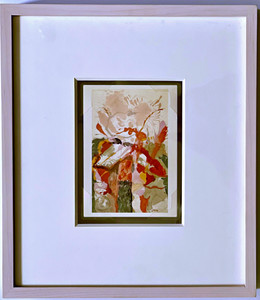

Art Card: Maurice Sendak - "I Have No Business Cards So I Hope This Will Do", 1989
Maurice SendakCONTACT GALLERY FOR PRICE
Art Card: Maurice Sendak - "I Have No Business Cards So I Hope This Will Do", 1989
Offset lithograph postcard (Hand Signed and Inscribed by Maurice Sendak)
Maurice Sendak
Offset lithograph postcard
Maurice Sendak autographed this card which he inscribed with this message: "I Have No Business Cards So I Hope This Will Do"
This is a unique and totally adorable hand signed collectible. In response to a request for a business card, the famous illustrator and children's book writer Maurice Sendek autographed this card which he inscribed with this message: "I Have No Business Cards So I Hope This Will Do"
This vintage card itself depicts Maurice Sendek's 1988 Design for Silk Scarf Representing A Wild Thing
This work has been floated and framed in a museum quality wood frame under two sided plexiglass to reveal the signature and inscription on the other side of the image. The framer has used plastic pocket corners at the edges so that the full image is shown.
Measurements:
Framed:
11.5 inches (vertical) by 13.75 inches (horizontal) by 2 inches
Artwork:
4 inches (vertical) by 6 inches (horizontal)
MAURICE SENDEK BIOGRAPHY
(1928-2012)
Synopsis
Maurice Sendak was born on June 10, 1928 in New York City. The now-renowned children's author studied at the Art Students League and illustrated more than 80 books by other writers before authoring one himself. His most critically acclaimed work includes the dark and beloved story Where the Wild Things Are. Later in his career Sendak collaborated with Carole King on the musical Really Rosie and has done other work for the stage.
Early Years
Beloved children's book author and illustrator Maurice Sendak grew up in Brooklyn, New York. The son of a dressmaker, he was a sickly child who started drawing to pass the time. Sendak excelled at art, landing a part-time job at All-American Comics while in high school.
While working on window displays for New York's famed toy store F.A.O. Schwarz in the late 1940s, Sendak met legendary children's book editor Ursula Nordstrom. She helped Sendak land his first job illustrating children's books. During the 1950s, he worked on books by such authors as Ruth Krauss and Else Holmelund Minarik.
Critical Acclaim
In 1956, Sendak published Kenny's Window, the first children's book he both wrote and illustrated himself. Before long, he turned the children's book world upside down with his 1963 masterpiece Where the Wild Things Are. Sendak captured the public's imagination with this tale of a boy's journey into a strange land inhabited by grotesque yet appealing monsters.
Sendak's dark, moody illustrations were a shocking contrast to the usually light and happy fare found in a typical children's book of the time. The main character Max, like many of Sendak's protagonists, acted like a real child, not some idealized version of youth.
"In plain terms, a child is a complicated creature who can drive you crazy," Sendak once said in an interview. "There's a cruelty to childhood, there's an anger. And I did not want to reduce Max to the trite image of the good little boy that you find in too many books." Where the Wild Things Are earned Sendak a Caldecott Medal, a special honor for children's book illustration.
During his long career, Sendak produced more than 50 books, including In the Night Kitchen (1970) and Outside Over There (1981). He also used his creative talents in a number of other forms, collaborating with Carole King for the musical Really Rosie. Sendak designed sets and costumes for stage versions of his books and other productions as well. In early 1980s, he created the sets for several operas, including Mozart's Magic Flute at the House Grand Opera.
Sendak's dark, moody illustrations were a shocking contrast to the usually light and happy fare found in a typical children's book of the time. The main character Max, like many of Sendak's protagonists, acted like a real child, not some idealized version of youth.
"In plain terms, a child is a complicated creature who can drive you crazy," Sendak once said in an interview. "There's a cruelty to childhood, there's an anger. And I did not want to reduce Max to the trite image of the good little boy that you find in too many books." Where the Wild Things Are earned Sendak a Caldecott Medal, a special honor for children's book illustration.
During his long career, Sendak produced more than 50 books, including In the Night Kitchen (1970) and Outside Over There (1981). He also used his creative talents in a number of other forms, collaborating with Carole King for the musical Really Rosie. Sendak designed sets and costumes for stage versions of his books and other productions as well. In early 1980s, he created the sets for several operas, including Mozart's Magic Flute at the House Grand Opera.