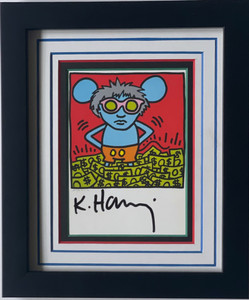
Art Card - Duane Hanson - The Traveler, (Hand Signed by Duane Hanson), 1985, 1988
Duane HansonCONTACT GALLERY FOR PRICE
Art Card - Duane Hanson - The Traveler, (Hand Signed by Duane Hanson), 1985, 1988
This offset lithograph card depicts Duane Hanson's famous 1988 sculpture "Traveler", which is famously installed in Terminal A at Orlando International Airport -- to the delight and confusion of millions of actual travelers.
Created in 1985, The Traveler depicts an exhausted man resting on his luggage,
capturing a moment of fatigue often mistaken for a real person.
Duane Hanson was renowned for creating life-sized, incredibly lifelike sculptures of ordinary people using materials like fiberglass, polyester resin, and oil paint.
This card, has, exceptionally, been signed in black marker by the artist. A true collectible when hand signed. Hanson died in 1988 - long before the Internet, so there just aren't too many pieces like this hand signed by the artist.
It has been elegantly matted with three different color mats in a white wood frame under UV plexiglass.
Measurements:
Framed
16.5 inches (vertical) by 18.5 inches (horizontal) by 2 inches
Art Card:
6 inches (vertical) by 8 inches (horizontal)
DUANE HANSON BIOGRAPHY
Duane Hanson began casting from live models in 1967 and for several years created expressionist tableaux addressing politically charged subjects such as the race riots of 1968 and the Vietnam War. By the early 1970s he increasingly focused on the individual figure, refining his lifelike sculptures by hand-painting their skin and clothing them with carefully selected garments and props. Depicting archetypes from everyday American life, the hyperreal sculptures are easily mistaken for live people. Hanson is often associated with the Photorealist movement that emerged during this period, but unlike these painters, who meticulously copied photographs, Hanson blended different models, gestures, and expressions for emotional impact. His characters are chosen to highlight the daily lives of lower- and middle-class Americans—construction workers, museum guards, old women, and policemen in forlorn poses. Like Edward Hopper’s subjects, they articulate the loneliness and resignation of the individual in modern society.
-Courtesy Whitney Museum
-

-
-
Christo, Art Card: Wrapped Portrait of Jeanne-Claude, 1963 (Hand Signed), 1988
Christo (Christo and Jeanne Claude)
-
Christo and Jeanne-Claude, Art Card: The Pont Neuf Wrapped (Hand Signed by Christo), 1985
AUD0.00Christo (Christo and Jeanne Claude)
-