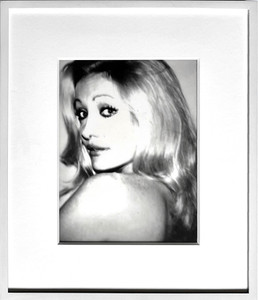
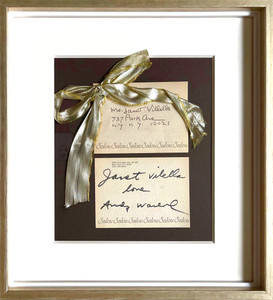
Andy Warhol, Original acetate positive for Ladies & Gentlemen, ca. 1975 Acetate positive
Andy WarholCONTACT GALLERY FOR PRICE
Andy Warhol
Original acetate positive for Ladies & Gentlemen, ca. 1975
Acetate positive
Acetate positive photograph
Provenance: Andy Warhol's Studio (The Factory) via Chromacomp, Inc. (Warhol's printer, owned by Eunice & Jack Lowell)
Framed in a museum quality white wood frame under UV plexiglass.
Measurements:
Framed
21 inches (vertical) by 17.5 inches (horizontal) by 1.5 inches
Acetate:
15 inches (vertical) by 12 inches) (horizontal) (spprox - unevenly cut by Warhol himself)
In April 2014, a selection of Andy Warhol acetates from the "Ladies & Gentlemen" series from the Chromacomp collection - similar to this one - also acquired from our gallery, were featured in a hugely popular exhibition entitled "Andy Warhol: Storefronts" at the Palazzo della Arti Napoli, Italy. Below is a link to images from this exhibition, featuring the Warhol acetates, just like this one:
https://www.facebook.com/media/set/?set=a.10152367552734907.1073742109.357051884906&type=1&stream_ref=10
Note: This lot is for the original UNIQUE black and white acetate positive (header image) which was one of the acetates used by Warhol to create the color silkscreen multiple for the Ladies & Gentlemen series.
This is an original, black and white photographic positive acetate taken by Andy Warhol that came directly from Andy Warhol's studio to his printer....As Bob Colacello, Editor in Chief of Interview Magazine and right hand man to Warhol, explained, "many hands were involved in the rather mechanical silkscreening process...but only Andy in all the years I knew him, worked on the acetates." An acetate is a photographic negative transferred to a transparency, allowing an image to be magnified and projected onto a screen. As only Andy worked on the acetates, it was the last original step prior to the screenprinting of an image, and the most important element in Warhol's creative process for silkscreening.
The idea for the the Ladies and Gentlemen series (consisting of images of drag queens) came from a protege of art dealer Alexander Iolas named Anselmino, who had previously commissioned Warhol to do an edition of one hundred prints of Warhol's Man Ray portrait. When Warhol went to Torino to sign the prints, Anselmino suggested he do a series of drag queens, suggesting portraits of Jackie Curtis, Holly Woodlawn and Candy Darling - not realizing that Candy Darling was dead. Instead, Warhol used models found at the The Gilded Grape on West 45th Street, frequented by Black and Hispanic transvestites."
The Ladies & Gentlemen Series represents some of the most interesting portraits Warhol created while also depicting Warhol's acute awareness of the modernizing and liberalizing world around him.
Unlike the portraits commissioned by socialites and celebrities, Warhol paid these sitters to pose in front of his camera. In a statement made by Vincent Fremont about the sitters he says, “Bob Colacello found most of them at a club called the Gilded Grape. After the photo session, I would hand the subjects a model release and a check and send them over to the bank. The cross-dressers were invited to pose and dress as they wished while Warhol took their portraits with his Polaroid Big Shot camera, the same process he used with the Hollywood starlets and socialites. The photographs were then sent to a commercial silkscreen shop where they were transferred onto the silk or silk-like fabric and then returned to Warhol for printing. These paintings are glamorous and feminine, and mimic the celebrity status of his other portraits. To Warhol, the Ladies and Gentlemen were starlets but their ambiguity and anonymity veered these paintings away from the commerciality with which his work was once affiliated.”
This acetate was brought by Warhol to Eunice and Jackson Lowell, owners of Chromacomp, a fine art printing studio in NYC, and was acquired directly from the Lowell's private collection. (During the 1970s and 80s, Chromacomp was the premier atelier for fine art limited edition silkscreen prints; indeed, Chromacomp was the largest studio producing fine art prints in the world for artists such Robert Natkin, David Hockney, Warhol and many more.)
Famed printer Alexander Heinrici worked for Eunice & Jackson Lowell at Chromacomp and brought Andy Warhol in as an account. Shortly after, Warhol or his workers brought in several boxes of photographs, paper and/or acetates and asked Jackson Lowell to use his equipment to enlarge certain images or portions of images. Warhol made comments and or changes and asked the Lowells to print some editions. After completing the Ladies & Gentlemen series, Warhol left the remaining acetates, including this one, with Eunice and Jackson Lowell. After the Lowells closed the shop, the photographs were packed away where they remained for nearly a quarter of a century.
The present work is in the condition that it was delivered to the printer; some is natural wear and some is rouge paste which Warhol used for countouring and shaping; part of his creative process.
This acetate was brought by Warhol to Eunice and Jackson Lowell, owners of Chromacomp, a fine art printing studio in New York City. During the 1970s and 1980s, Chromacomp was the premier atelier for fine art limited edition silkscreen prints; indeed, Chromacomp was the largest studio producing fine art prints in the world for artists such as Andy Warhol, Leroy Neiman, Erte, Robert Natkin, Larry Zox, David Hockney and many more. All of the plates were done by hand and in some cases photographically. As a testament to the historical importance of this collection, we recently sold Andy Warhol's acetate of Conceptual Artist Joseph Kosuth (from this collection) -- to the artist Joseph Kosuth - himself
Provenance: Andy Warhol's Studio (The Factory) via Chromacomp, Inc. (Warhol's printer, owned by Eunice & Jack Lowell)
Framed in a museum quality white wood frame under UV plexiglass.
Measurements:
Framed
21 inches (vertical) by 17.5 inches (horizontal) by 1.5 inches
Acetate:
15 inches (vertical) by 12 inches) (horizontal) (spprox - unevenly cut by Warhol himself)
In April 2014, a selection of Andy Warhol acetates from the "Ladies & Gentlemen" series from the Chromacomp collection - similar to this one - also acquired from our gallery, were featured in a hugely popular exhibition entitled "Andy Warhol: Storefronts" at the Palazzo della Arti Napoli, Italy. Below is a link to images from this exhibition, featuring the Warhol acetates, just like this one:
https://www.facebook.com/media/set/?set=a.10152367552734907.1073742109.357051884906&type=1&stream_ref=10
Note: This lot is for the original UNIQUE black and white acetate positive (header image) which was one of the acetates used by Warhol to create the color silkscreen multiple for the Ladies & Gentlemen series.
This is an original, black and white photographic positive acetate taken by Andy Warhol that came directly from Andy Warhol's studio to his printer....As Bob Colacello, Editor in Chief of Interview Magazine and right hand man to Warhol, explained, "many hands were involved in the rather mechanical silkscreening process...but only Andy in all the years I knew him, worked on the acetates." An acetate is a photographic negative transferred to a transparency, allowing an image to be magnified and projected onto a screen. As only Andy worked on the acetates, it was the last original step prior to the screenprinting of an image, and the most important element in Warhol's creative process for silkscreening.
The idea for the the Ladies and Gentlemen series (consisting of images of drag queens) came from a protege of art dealer Alexander Iolas named Anselmino, who had previously commissioned Warhol to do an edition of one hundred prints of Warhol's Man Ray portrait. When Warhol went to Torino to sign the prints, Anselmino suggested he do a series of drag queens, suggesting portraits of Jackie Curtis, Holly Woodlawn and Candy Darling - not realizing that Candy Darling was dead. Instead, Warhol used models found at the The Gilded Grape on West 45th Street, frequented by Black and Hispanic transvestites."
The Ladies & Gentlemen Series represents some of the most interesting portraits Warhol created while also depicting Warhol's acute awareness of the modernizing and liberalizing world around him.
Unlike the portraits commissioned by socialites and celebrities, Warhol paid these sitters to pose in front of his camera. In a statement made by Vincent Fremont about the sitters he says, “Bob Colacello found most of them at a club called the Gilded Grape. After the photo session, I would hand the subjects a model release and a check and send them over to the bank. The cross-dressers were invited to pose and dress as they wished while Warhol took their portraits with his Polaroid Big Shot camera, the same process he used with the Hollywood starlets and socialites. The photographs were then sent to a commercial silkscreen shop where they were transferred onto the silk or silk-like fabric and then returned to Warhol for printing. These paintings are glamorous and feminine, and mimic the celebrity status of his other portraits. To Warhol, the Ladies and Gentlemen were starlets but their ambiguity and anonymity veered these paintings away from the commerciality with which his work was once affiliated.”
This acetate was brought by Warhol to Eunice and Jackson Lowell, owners of Chromacomp, a fine art printing studio in NYC, and was acquired directly from the Lowell's private collection. (During the 1970s and 80s, Chromacomp was the premier atelier for fine art limited edition silkscreen prints; indeed, Chromacomp was the largest studio producing fine art prints in the world for artists such Robert Natkin, David Hockney, Warhol and many more.)
Famed printer Alexander Heinrici worked for Eunice & Jackson Lowell at Chromacomp and brought Andy Warhol in as an account. Shortly after, Warhol or his workers brought in several boxes of photographs, paper and/or acetates and asked Jackson Lowell to use his equipment to enlarge certain images or portions of images. Warhol made comments and or changes and asked the Lowells to print some editions. After completing the Ladies & Gentlemen series, Warhol left the remaining acetates, including this one, with Eunice and Jackson Lowell. After the Lowells closed the shop, the photographs were packed away where they remained for nearly a quarter of a century.
The present work is in the condition that it was delivered to the printer; some is natural wear and some is rouge paste which Warhol used for countouring and shaping; part of his creative process.
This acetate was brought by Warhol to Eunice and Jackson Lowell, owners of Chromacomp, a fine art printing studio in New York City. During the 1970s and 1980s, Chromacomp was the premier atelier for fine art limited edition silkscreen prints; indeed, Chromacomp was the largest studio producing fine art prints in the world for artists such as Andy Warhol, Leroy Neiman, Erte, Robert Natkin, Larry Zox, David Hockney and many more. All of the plates were done by hand and in some cases photographically. As a testament to the historical importance of this collection, we recently sold Andy Warhol's acetate of Conceptual Artist Joseph Kosuth (from this collection) -- to the artist Joseph Kosuth - himself