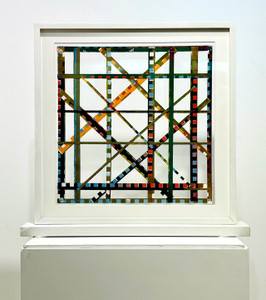
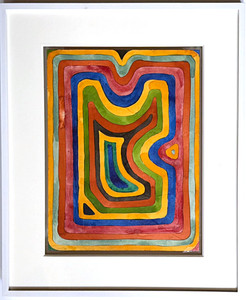
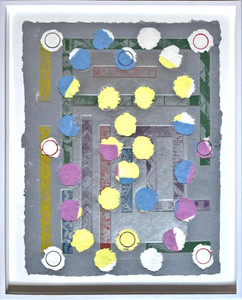
Alan Shields - Houston Oil, 1974
Color silkscreen collage with relief, embossing, thread and cut paper
Color silkscreen collage with relief, embossing, thread and cut paper
Signed 'Alan Shields', titled 'Houston Oil', dated '74 and numbered 4/21 on the front
Houston Oil (1974) is a rare, highly intricate mixed-media print from an edition of 21, that exquisitely showcases Alan Shields’ radical subversion of traditional printmaking
This work has been elegantly floated and framed in a museum quality wood frame under UV plexiglass.
Measurements:
Framed:
14.25 inches (vertical) by 14.75 inches (horizontal) by 2 inches
Artwork:
6.25 inches (vertical) by 6.75 inches (horizontal)
Houston Oil (1974) was printed and produced at the Jones Road Print Shop and Stable in Barneveld, Wisconsin. It was co-published by The Shenanigan Press, Ltd. and Omar Space Corporation (based out of Madison, WI and New York). The workshop was founded by William "Bill" Weege, an incredibly innovative printmaking professor at the University of Wisconsin-Madison. Weege converted an old barn in rural Barneveld into a radical, experimental print shop. The shop famously featured commercial sewing machines, industrial die-cutters, and custom papermaking vats. Shields and Weege worked side-by-side as master printers. To make Houston Oil, they physically stenciled, layered, embossed, and individually machine-stitched the components together on-site in the barn. To fund and distribute these wildly complex, non-traditional print projects, Weege and Shields established The Shenanigan Press, Ltd. The name itself perfectly captured the playful, rule-breaking spirit of their collaboration. They teamed up with Omar Space Corporation to officially publish and distribute the editions, which were then prominently showcased back in New York via the Paula Cooper Gallery
In 1974, when this work was made, "Houston Oil" was an unavoidable phrase dominating American news and public consciousness. The historic 1973–1974 OPEC Oil Embargo had just triggered massive domestic energy anxieties, skyrocketing gas lines, and a monumental economic shift that firmly solidified Houston as the booming "Energy Capital of the World."
According to archival background from his long-time representation at the Paula Cooper Gallery, Shields chose titles—such as Detroit, Goo, Chicken Shit, and The Top is Not Here—expressly to toy with the limitations of naming. His titles functioned similarly to New York School poetry: hyper-specific in their everyday pop-culture or industrial references, yet entirely open to whimsical interpretation. Naming a delicate, vibrantly colored, hand-stitched 6-inch paper-and-thread construction Houston Oil creates a humorous, ironic friction. It deliberately juxtaposes the massive, gritty, masculine, and geopolitical weight of the global oil industry against a fragile, kaleidoscopic, and intensely intimate work of craft art.
. Rather than a flat, standard impression, the work is a miniature dimensional collage constructed from a complex combination of screenprint in colors, relief, embossing, machine-stitched thread, and cut paper.
Tweaking the Grid: Shields wanted to liberate both painting and printmaking from their traditional constraints. By introducing sewing, tactile texture, and double-sided dimensionality to small-scale paper works, he transformed prints into interactive, tactile sculpture-hybrids
Raised on a farm in Kansas, Shields learned to sew from his mother and sisters. He weaponized this "low" craft skill within the high-art context of 1970s Postminimalism, treating the sewing machine as a drawing tool to hold his multi-layered, color-stenciled handmade papers together.