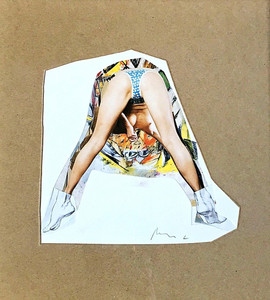
Richard Prince - Untitled Anti-War posters from Public Poster Program, 2017
Richard PrinceCONTACT GALLERY FOR PRICE
Richard Prince - Untitled Anti-War posters from Public Poster Program, 2017
2 layer silkscreen on C-MAT 150 gram paper
2 layer silkscreen on C-MAT 150 gram paper
Signed and numbered 11/25 (+ 5 A.P)
Published by MORE Publishers, Belgium (sold out)
This hand signed and numbered print depicts a nude guy named Ryer huddled surrounded by anti-war and protest posters:
Suppose they gave a war and nobody came
When the bomb goes off, make sure you’re HIGHER than the bomb!
War’s not healthy for children & other living things
They shoot students, don’t they?
From the Vietnam War to Woodstock to Kent State, the cultural context of the late 60s and early 70s has been a regular feature in Prince’s discussions of his work. The work itself, meanwhile, is grounded in images circulated in magazines, and ads. Prince has written about “ganging” slides of rephotographed magazine images, “DJ’ing” them into various arrangements and printing the grid of slides on a single sheet.
This print depicts a catalog sheet of vintage anti-war posters from the 1960s, featuring works by Lorraine Schneider and other topical designs.
"War's Not Healthy...": The iconic 1967 poster design by Lorraine Schneider featuring a sunflower, titled "Primer," originally intended to highlight the tragic deaths of children in war.
"When the Bomb Goes Off": A caustically topical lithograph poster from the era, designed to provoke thought about nuclear conflict.
"Suppose They Gave a War...": A classic, simple slogan poster emphasizing pacifism, often printed in bold "Dayglo" colors.
Other Designs: The catalog includes other protest art, such as posters questioning the shooting of students during protests, along with pricing and sizing information for canvas and paper prints.
RICHARD PRINCE BIOGRAPHY
Born in 1949 in the Panama Canal Zone, then a United States territory, Richard Prince moved to a suburb of Boston in 1954. In 1973, after applying to the San Francisco Art Institute without success, he moved to New York, where he became familiar with Conceptual art. While working in the Time-Life Building as a preparer of magazine clippings, he realized the possibilities of using advertising imagery—all that would be left after he cut out articles—as an element in his art. Early works such as Untitled (Cigarettes) (1978–79) and Untitled (three women looking in the same direction) (1980) consist of found advertising images, rephotographed and juxtaposed with one another by the artist. The deliberately artificial look of the photographs linked Prince to contemporaries such as Cindy Sherman and Jack Goldstein, who were also using photography to blur the line between reality and artifice. Prince’s decontextualization of found photographs and interest in consumer culture also situated him alongside emerging appropriation artists, including Barbara Kruger and Sherrie Levine.
Prince was involved in the downtown New Wave scene at this time; he played in bands and was a regular at the Mudd Club and other rock venues. During the early 1980s, Prince developed a process that resulted in grids of juxtaposed images, which he referred to as “gangs.” In works such as Entertainers (1982–83), he joined together multiple 35 mm slides of images from advertisements and magazines to form one larger negative, from which the final print was made. Each “gang” focused on a particular pop-culture motif of desire, including car hoods, bikers, pornography, cowboys, and sunsets. He also began taking his own photographs. For the series Girlfriends (1992), Prince photographed women who had appeared in biker magazines, re-creating their magazine images.
In the late 1980s, Prince began painting texts of jokes against abstract, often monochromatic backgrounds, as in The Wrong Joke (1989). He also started painting directly onto found materials such as tires and car hoods, creating hybrids of painting and sculpture, including Untitled (Hoods) (1989). In the mid-’90s, he photographed around his home in upstate New York, concentrating on mundane suburban details. His series Nurses (2002–06) juxtaposes the popular icon of ’50s and ’60s pulp-fiction paperbacks with elusive text cloistered within menacing abstract backgrounds.
Prince has had individual presentations at such venues as Artists Space, New York (1980); Institute of Contemporary Arts, London (1983); Magasin, Centre National d’Art Contemporain Grenoble, France (1988); Centre del Carme, Valencia, Spain (1989); Whitney Museum of American Art, New York (1992); Museen Haus Lange, Krefeld, Germany (1997); MAK, Vienna, and MAK Center for Art and Architecture, Los Angeles (2000); Museum für Gegenwartskunst, Basel (2001); Solomon R. Guggenheim Museum, New York (2007–08, travelled to the Walker Art Center, Minneapolis, and Serpentine Gallery, London [both 2008]); and Kunsthaus Bregenz, Austria (2014). His work has appeared in the Vienna International Biennial (1981), São Paolo Biennial (1983), Whitney Biennial (1985, 1987, 1997, and 2004), Sydney Biennial (1986), Venice Biennale (1988 and 2007), and Documenta (1992), as well as in many group exhibitions, including Art et publicité 1890–1990, Centre Georges Pompidou, Paris (1990–91), Around 1984: A Look at Art in the Eighties, P.S.1 Contemporary Art Center, New York (2000); Surprise, Surprise, Institute of Contemporary Arts, London (2006); Street and Studio, Tate Modern, London (2008); and The Pictures Generation, Metropolitan Museum of Art, New York (2009). He is one of six artist-curators who made selections for Artistic License: Six Takes on the Guggenheim Collection, Solomon R. Guggenheim Museum (2019–20). Prince lives and works in upstate New York.
-Courtesy Guggenheim