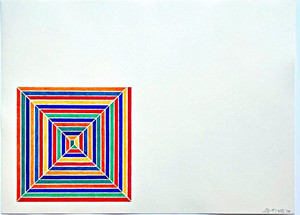
Frank Stella, Plutusia, from Imaginary Places II (Axsom & Schnitzer, 246), 1996
AUD0.00
Frank Stella
Alpha 137 Gallery and Art Advisory
In business for nearly two decades, we are a well established, popular contemporary art boutique specializing in expertly chosen prints, multiples, and unique sculptures, design objects, works on paper and paintings by recognized artists, with a focus on the secondary market. We also have an impressive selection of scarce and coveted art historical ephemera, monographs and merchandise at different price points. Discover our small business: one of the best kept secrets in the art world, and join our ever-growing family of art lovers - from first time collectors to seasoned fine art professionals. Please note that works are available for purchase exclusively online, and we are not able to accommodate requests for in person viewings at this time.
For a short order art appraisal, please click the "Art Appraisal Services" option above. To reach us, click on the
Contact Us option above or at the bottom of this page.
An educated collector is our best client


CONTACT GALLERY FOR PRICE
Frank Stella
Luis Miguel Dominguin, from the Aluminum Series (Axsom, Schnitzer & Gemini), 1970
Lithograph and silkscreen in gray and silver on Special Arjomari paper
Signed, dated '70 and numbered 59/75 in graphite pencil on the front
bears the GEMINI GEL blind stamp recto
Printed by Gemini G.E.L, Los Angeles and published by Gemini G.E.L, Los Angeles
This work is elegantly floated and framed in a museum quality painted wood frame under UV plexiglass.
Measurements:
Framed:
18.25 inches (vertical) by 25.25 inches (horizontal) by 2 inches
Artwork
16 inches (vertical) by 22 inches (horizontal)
Catalogue Raisonne References:
Axsom, Richard H. The Prints of Frank Stella: A Catalogue Raisonné. New York: Jordan Schnitzer Family Foundation, 2016. Listed and illustrated as catalogue raisonné no. 35.
Gemini Gel: 210
The title references a Spanish bullfighter, part of a series where Stella used literary and glamorous allusions for his abstract works.
Other examples of this edition are in the permanent collections of several museums, including the Whitney Museum of American Art and the Buffalo AKG Art Museum.
More about Frank Stella's Aluminum Series:
The Frank Stella Aluminum Series, created around 1970, is a significant body of work in the artist's career that bridges his early minimalist paintings with his later move into three-dimensional, shaped canvases and reliefs. The series exists both as paintings (begun earlier, around 1960) and as a portfolio of nine lithographs and silkscreens.
Key Characteristics
• Materiality: The works use aluminum as the surface material for the paintings, or as the title for the print series. The metallic appearance gave the works an industrial feel.
• Geometric Abstraction: The series continues Stella's exploration of geometric forms and patterns, which had begun with his earlier Black Paintings.
• Shaped Canvases/Forms: The Aluminum works, particularly the paintings, are known for their shaped canvases. These were often notched or cut into forms like L's, T's, or U's. The internal painted stripes often mirrored the external shape of the canvas, reinforcing the objecthood of the work.
• Repetition and Logic: The compositions were governed by a systematic, internal logic. They often used repeated, parallel stripes separated by thin lines of unpainted surface. Stella used tape to ensure the regularity of the gaps in some of these works.
• Printmaking Innovation: The Aluminum Series print portfolio, produced in collaboration with Gemini G.E.L., continued these aesthetic ideas in a different medium. Stella explored the possibilities of lithography and screenprinting to achieve varied textures and resolutions, translating the look of his paintings into print form.
FRANK STELLA BIOGRAPHY
Frank Stella was born in 1936 in Malden, Massachusetts. After attending high school at Phillips Academy in Andover, Massachusetts, he went on to Princeton University, where he painted and majored in history. Early visits to New York art galleries would prove to be an influence upon his artistic development. Stella moved to New York in 1958 after his graduation.
Stella’s art was recognized for its innovations before he was twenty-five. In 1959, several of his paintings were included in Three Young Americans at the Allen Memorial Art Museum at Oberlin College, as well as in Sixteen Americans at the Museum of Modern Art in New York (1959–60). Stella joined dealer Leo Castelli’s stable of artists in 1959. In his early series, including the Black Paintings (1958–60), Aluminum Paintings (1960), and Copper Paintings (1960–61), Stella cast aside illusionistic space for the physicality of the flat surface and deviated from the traditional rectangular-shaped canvas. Stella married Barbara Rose, later a well-known art critic, in 1961.
Stella’s Irregular Polygon canvases (1965–67) and Protractor series (1967–71) further extended the concept of the shaped canvas. Stella began his extended engagement with printmaking in the mid-1960s, working first with master printer Kenneth Tyler at Gemini G.E.L. In 1967, Stella designed the set and costumes for Scramble, a dance piece by Merce Cunningham. The Museum of Modern Art in New York presented a retrospective of Stella’s work in 1970. During the following decade, Stella introduced relief into his art, which he came to call “maximalist” painting for its sculptural qualities. Ironically, the paintings that had brought him fame before 1960 had eliminated all such depth. After introducing wood and other materials in the Polish Village series (1970–73), created in high relief, he began to use aluminum as the primary support for his paintings. As the 1970s and 1980s progressed, these became more elaborate and exuberant. Indeed, his earlier Minimalism became baroque, marked by curving forms, DayGlo colors, and scrawled brushstrokes. Similarly, his prints of these decades combined various printmaking and drawing techniques. In 1973, he had a print studio installed in his New York house.
From the mid-1980s to the mid-1990s, Stella created a large body of work that responded in a general way to Herman Melville’s Moby Dick. During this time, the increasingly deep relief of Stella’s paintings gave way to full three-dimensionality, with sculptural forms derived from cones, pillars, French curves, waves, and decorative architectural elements. To create these works, the artist used collages or maquettes that were then enlarged and re-created with the aid of assistants, industrial metal cutters, and digital technologies.
In the 1990s, Stella began making freestanding sculpture for public spaces and developing architectural projects. In 1992–93, for example, he created the entire decorative scheme for Toronto’s Princess of Wales Theatre, which includes a 10,000-square-foot mural. His 1993 proposal for a kunsthalle (arts center) and garden in Dresden did not come to fruition. His aluminum bandshell, inspired by a folding hat from Brazil, was built in downtown Miami in 1999. In 2001, a monumental Stella sculpture was installed outside the National Gallery of Art in Washington, D.C.
Stella’s work was included in several important exhibitions that defined 1960s art, among them the Solomon R. Guggenheim Museum’s The Shaped Canvas (1964–65) and Systemic Painting (1966). His art has been the subject of several retrospectives in the United States, Europe, and Japan. Among the many honors he has received was an invitation from Harvard University to give the Charles Eliot Norton lectures in 1983–84. Calling for a rejuvenation of abstraction by achieving the depth of baroque painting, these six talks were published by Harvard University Press in 1986.
-Courtesy Guggenheim
Frank Stella