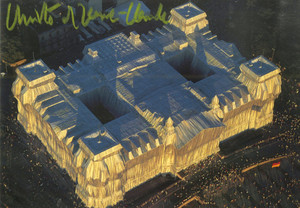
Christo and Jeanne-Claude, Berlin 1995: Der von Christo und Jeanne-Claude verhüllte Reichstag (Hand Signed by Christo and Jeanne-Claude), 1995
Christo (Christo and Jeanne Claude)CONTACT GALLERY FOR PRICE
Christo and Jeanne-Claude
Berlin 1995: Der von Christo und Jeanne-Claude verhüllte Reichstag (Hand Signed by Christo and Jeanne-Claude), 1995
Art Card: Reichstag at Night (Berlin 1995: Der von Christo und Jeanne-Claude verhüllte Reichstag), Hand Signed by Christo and Jeanne-Claude, 1995
Offset lithograph card (Hand signed Christo et Jeanne-Claude)
Offset lithograph card (Hand Signed Christo et Jeanne-Claude)
Acquired from the private collection of Jeanne-Claude's assistant and book collaborator, who received it as a gift from Christo.
The project to wrap the German Parliament building was conceived by Christo and his wife Jeanne-Claude in the early 1970s, but was not realized until the 1990s. The structure was wrapped in polypropylene fabric, with 17,060 yards of bright blue rope holding it tight against the 220 tons of steel structure to which the wrapping was attached. A New York Times feature on the project described it as follows: "Wrapped Reichstag, by Christo and his wife, Jeanne-Claude, is at once a work of art, a cultural event, a political happening and an ambitious piece of business. It has got Berlin into more of a celebratory mood than anything since the fall of the wall .... and as the immense project of wrapping the 101-year-old German Parliament building in more than a million square feet of aluminum-colored fabric nears its completion, crowds gather day and night to gawk, to cheer as sections of cloth are unfurled, and to watch for glimpses of the New York artist couple who are treated here like rock stars." Paul Goldberger, who wrote the Times feature, describes the cultural, as well as aesthetic impact of wrapping the Reichstag at that moment in history. "This immense stone hulk, a heavy, bombastic building that epitomizes German excesses of the late 19th century, is rendered light, almost delicate. It takes on an ethereal beauty, and looks as if it could float away into the silvery, cloudy Berlin sky." Decades later, Christo, would reflect on the fact that the New York Times dispatched their architecture critic, Paul Goldberger, to review the project - instead of their esteemed art reviewer, because in those years, Christo's work was not considered art, and perhaps they didn't know quite what it was!
This work has been elegantly float framed in a museum quality frame under UV plexiglass.
Measurements:
Framed
9 inches by 11 inches by 1
4 inches by 6 inches
Christo Biography
Christo Javacheff and Jeanne-Claude de Guillebon were both born in 1935, he in Gabrova, Bulgaria, and she in Casablanca, Morocco. (They would drop their surnames early on.) Christo studied at the Fine Arts Academy in Sofia (1953–56) before defecting to the West, via Prague, in 1957. That year, he spent one semester at the Akademie der Bildenden Künste in Vienna. He moved to Paris in 1958 and met Jeanne-Claude, who had earned her baccalaureate in Latin and philosophy from the University of Tunis in 1952. They would later marry.
Indebted to Vladimir Tatlin's Constructivist edict "real materials in real space," Christo's first artworks, dating from 1958, consist of appropriated everyday objects such as bottles, cans, furniture, and oil drums wrapped in canvas, bundled in twine, and occasionally overlaid with automobile paint. His first solo exhibition, at Galerie Haro Lauhus in Cologne in June 1961, included his inaugural collaboration with Jeanne-Claude (though she would not publicly acknowledge her role in their creations until 1994), Dockside Packages, a collection of draped oil barrels and rolls of industrial paper arranged outside the gallery along a dock. That same year, the couple made their first attempt at exploring their aesthetic vocabulary on a monumental scale with Project for a Wrapped Public Building, in which they proposed shrouding an unspecified parliamentary edifice, the quintessential symbol of public architecture, in fabric tied down with metal cables. Never realized, the project exists in the form of a photographic collage with an explanatory text by the artists.
Throughout the 1960s, Christo and Jeanne-Claude outlined proposals for similar projects, often involving iconic buildings, like the École Militaire station of the Paris Métro (1961). They saw their dreams come to fruition in the summer of 1968, when they received permission to carry out three of their undertakings: Wrapped Fountain, Piazza Mercato, Spoleto, Italy, 1968; Wrapped Medieval Tower, Spoleto, Italy, 1968; and Wrapped Kunsthalle, Bern, Switzerland, 1968. The following year, they cloaked both the Museum of Contemporary Art in Chicago and a mile-long section of the Australian coastline at Little Bay, north of Sydney. Covered with vast quantities of light-colored fabric, battened down using elaborate systems of cables, ropes, and knots, these architectural and natural forms were defamiliarized, transformed into ghostly presences that momentarily disrupted their surroundings.
Beginning in 1970, the artists executed numerous other projects, all of which became icons of environmental art: Valley Curtain, Grand Hogback, Rifle, Colorado, 1970–72, a curtain of orange nylon suspended across a valley; Running Fence, Sonoma and Marin Counties, California, 1972–76, more than twenty-four miles of white nylon fabric snaking across the countryside; Surrounded Islands, Biscayne Bay, Greater Miami, Florida, 1980–83, around six and a half million square feet of bright pink fabric floating around eleven islands; The Pont Neuf Wrapped, Paris, 1975–85, honey-hued fabric shrouding the city’s oldest bridge; The Umbrellas, Japan–USA, 1984–91, a scattering of 3,100 blue and yellow umbrellas in the valleys around Ibaraki prefecture, Japan, and Tejon Pass, California; Wrapped Reichstag, Berlin, 1971–95, the celebrated German government building swathed in silver fabric; and The Gates, Central Park, New York City, 1979–2005, more than 7,500 metal frames fitted with saffron fabric panels and arranged along some twenty-three miles of walkway in Central Park. Due to the staggering cost and increasing complexity of these ventures, in terms of technical know-how as well as the administrative and environmental hurdles the artists were obligated to surmount, realization often took years, even decades. Unrealized projects, still considered ongoing, include The Mastaba, a plan for a monumental edifice of stacked oil barrels intended for a desert location in the United Arab Emirates, and Over the River, which would feature intermittent extensive canopies of fabric suspended above a 5.9-mile stretch of the Arkansas River.
In his solo work, Christo continues to conceive projects, some existing on paper only, in which found objects—from magazines, newspapers, and street signs, to nude female models, telephones, computers, and automobiles—are wrapped in fabric or plastic and then twined. These assemblages embody many of the themes Christo and Jeanne-Claude explored in their artistic partnership, among them the opposition between the familiar and the uncanny, the veiled and the exposed, the built and the natural environments, utility and futility, permanence and ephemerality.
Major exhibitions of the artists' work have been organized by the Institute of Contemporary Art in Boston (1979), Museum Ludwig in Cologne (1981), Hiroshima City Museum of Contemporary Art (1990), Martin-Gropius-Bau in Berlin (2001), and the Metropolitan Museum of Art in New York (2004). Jeanne-Claude died in 2009; Christo lives and works in New York City.
-Courtesy Guggenheim
Acquired from the private collection of Jeanne-Claude's assistant and book collaborator, who received it as a gift from Christo.
The project to wrap the German Parliament building was conceived by Christo and his wife Jeanne-Claude in the early 1970s, but was not realized until the 1990s. The structure was wrapped in polypropylene fabric, with 17,060 yards of bright blue rope holding it tight against the 220 tons of steel structure to which the wrapping was attached. A New York Times feature on the project described it as follows: "Wrapped Reichstag, by Christo and his wife, Jeanne-Claude, is at once a work of art, a cultural event, a political happening and an ambitious piece of business. It has got Berlin into more of a celebratory mood than anything since the fall of the wall .... and as the immense project of wrapping the 101-year-old German Parliament building in more than a million square feet of aluminum-colored fabric nears its completion, crowds gather day and night to gawk, to cheer as sections of cloth are unfurled, and to watch for glimpses of the New York artist couple who are treated here like rock stars." Paul Goldberger, who wrote the Times feature, describes the cultural, as well as aesthetic impact of wrapping the Reichstag at that moment in history. "This immense stone hulk, a heavy, bombastic building that epitomizes German excesses of the late 19th century, is rendered light, almost delicate. It takes on an ethereal beauty, and looks as if it could float away into the silvery, cloudy Berlin sky." Decades later, Christo, would reflect on the fact that the New York Times dispatched their architecture critic, Paul Goldberger, to review the project - instead of their esteemed art reviewer, because in those years, Christo's work was not considered art, and perhaps they didn't know quite what it was!
This work has been elegantly float framed in a museum quality frame under UV plexiglass.
Measurements:
Framed
9 inches by 11 inches by 1
4 inches by 6 inches
Christo Biography
Christo Javacheff and Jeanne-Claude de Guillebon were both born in 1935, he in Gabrova, Bulgaria, and she in Casablanca, Morocco. (They would drop their surnames early on.) Christo studied at the Fine Arts Academy in Sofia (1953–56) before defecting to the West, via Prague, in 1957. That year, he spent one semester at the Akademie der Bildenden Künste in Vienna. He moved to Paris in 1958 and met Jeanne-Claude, who had earned her baccalaureate in Latin and philosophy from the University of Tunis in 1952. They would later marry.
Indebted to Vladimir Tatlin's Constructivist edict "real materials in real space," Christo's first artworks, dating from 1958, consist of appropriated everyday objects such as bottles, cans, furniture, and oil drums wrapped in canvas, bundled in twine, and occasionally overlaid with automobile paint. His first solo exhibition, at Galerie Haro Lauhus in Cologne in June 1961, included his inaugural collaboration with Jeanne-Claude (though she would not publicly acknowledge her role in their creations until 1994), Dockside Packages, a collection of draped oil barrels and rolls of industrial paper arranged outside the gallery along a dock. That same year, the couple made their first attempt at exploring their aesthetic vocabulary on a monumental scale with Project for a Wrapped Public Building, in which they proposed shrouding an unspecified parliamentary edifice, the quintessential symbol of public architecture, in fabric tied down with metal cables. Never realized, the project exists in the form of a photographic collage with an explanatory text by the artists.
Throughout the 1960s, Christo and Jeanne-Claude outlined proposals for similar projects, often involving iconic buildings, like the École Militaire station of the Paris Métro (1961). They saw their dreams come to fruition in the summer of 1968, when they received permission to carry out three of their undertakings: Wrapped Fountain, Piazza Mercato, Spoleto, Italy, 1968; Wrapped Medieval Tower, Spoleto, Italy, 1968; and Wrapped Kunsthalle, Bern, Switzerland, 1968. The following year, they cloaked both the Museum of Contemporary Art in Chicago and a mile-long section of the Australian coastline at Little Bay, north of Sydney. Covered with vast quantities of light-colored fabric, battened down using elaborate systems of cables, ropes, and knots, these architectural and natural forms were defamiliarized, transformed into ghostly presences that momentarily disrupted their surroundings.
Beginning in 1970, the artists executed numerous other projects, all of which became icons of environmental art: Valley Curtain, Grand Hogback, Rifle, Colorado, 1970–72, a curtain of orange nylon suspended across a valley; Running Fence, Sonoma and Marin Counties, California, 1972–76, more than twenty-four miles of white nylon fabric snaking across the countryside; Surrounded Islands, Biscayne Bay, Greater Miami, Florida, 1980–83, around six and a half million square feet of bright pink fabric floating around eleven islands; The Pont Neuf Wrapped, Paris, 1975–85, honey-hued fabric shrouding the city’s oldest bridge; The Umbrellas, Japan–USA, 1984–91, a scattering of 3,100 blue and yellow umbrellas in the valleys around Ibaraki prefecture, Japan, and Tejon Pass, California; Wrapped Reichstag, Berlin, 1971–95, the celebrated German government building swathed in silver fabric; and The Gates, Central Park, New York City, 1979–2005, more than 7,500 metal frames fitted with saffron fabric panels and arranged along some twenty-three miles of walkway in Central Park. Due to the staggering cost and increasing complexity of these ventures, in terms of technical know-how as well as the administrative and environmental hurdles the artists were obligated to surmount, realization often took years, even decades. Unrealized projects, still considered ongoing, include The Mastaba, a plan for a monumental edifice of stacked oil barrels intended for a desert location in the United Arab Emirates, and Over the River, which would feature intermittent extensive canopies of fabric suspended above a 5.9-mile stretch of the Arkansas River.
In his solo work, Christo continues to conceive projects, some existing on paper only, in which found objects—from magazines, newspapers, and street signs, to nude female models, telephones, computers, and automobiles—are wrapped in fabric or plastic and then twined. These assemblages embody many of the themes Christo and Jeanne-Claude explored in their artistic partnership, among them the opposition between the familiar and the uncanny, the veiled and the exposed, the built and the natural environments, utility and futility, permanence and ephemerality.
Major exhibitions of the artists' work have been organized by the Institute of Contemporary Art in Boston (1979), Museum Ludwig in Cologne (1981), Hiroshima City Museum of Contemporary Art (1990), Martin-Gropius-Bau in Berlin (2001), and the Metropolitan Museum of Art in New York (2004). Jeanne-Claude died in 2009; Christo lives and works in New York City.
-Courtesy Guggenheim
-

-
Christo, Wrapped Reichstag (Hand Signed Christo et Jeanne Claude) from the collection of Jeanne-Claude's personal assistant, 1995
Christo (Christo and Jeanne Claude)
-
Christo and Jeanne-Claude, The Valley Curtain (Hand Signed by Christo and Jeanne-Claude), 1972
AUD0.00Christo (Christo and Jeanne Claude)
-
Christo and Jeanne-Claude, Christo, Javacheff Christo, Wrapped Trees, Switzerland (Hand Signed by Christo and Jeanne-Claude), 1998
Christo (Christo and Jeanne Claude)
-
Christo and Jeanne-Claude, Christo, Javacheff Christo, Wrapped Trees, Switzerland poster (Hand Signed by Christo and Jeanne-Claude), 1998
Christo (Christo and Jeanne Claude)