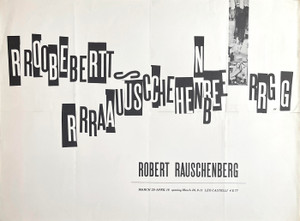
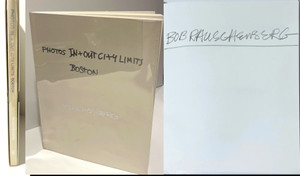
Robert Rauschenberg, Abstract Composition (Robert Rauschenberg #88.D109), 1988
$0.00
Robert Rauschenberg
Alpha 137 Gallery and Art Advisory
In business for nearly two decades, we are a well established, popular contemporary art boutique specializing in expertly chosen prints, multiples, and unique sculptures, design objects, works on paper and paintings by recognized artists, with a focus on the secondary market. We also have an impressive selection of scarce and coveted art historical ephemera, monographs and merchandise at different price points. Discover our small business: one of the best kept secrets in the art world, and join our ever-growing family of art lovers - from first time collectors to seasoned fine art professionals. Please note that works are available for purchase exclusively online, and we are not able to accommodate requests for in person viewings at this time.
For a short order art appraisal, please click the "Art Appraisal Services" option above. To reach us, click on the
Contact Us option above or at the bottom of this page.
An educated collector is our best client


Art Card: Robert Rauschenberg, Creek, 1964, 1988
Offset lithograph card
Provenance: Collection of Dan Pope, CBS News photographer who amassed an impressive collection of signed artist cards during the 1980s-1990s, acquired directly from the artists
Boldly signed in black marker by the artist on the front
The image depicted in this card is Rauschenbergs 1964 work "Creek", an oil on canvas collage held in the permanent collection of the Detroit Institute of Arts.
This work has been elegantly framed in a double matting with red beveled accent in a blue wood frame under UV plexiglass. It is ready to hang.
Measurements:
Framed
11.25 (vertical) by 13.25 (horizontal) by 1.25 inches
Card
4 inches (vertical) by 6 inches (horizontal
About Robert Rauschenberg:
Robert Rauschenberg imparted a legacy of innovation that continues to engage generations of artists, and although he eluded defining affiliations, his interdisciplinary practice positioned him at the forefront of nearly every artistic movement following Abstract Expressionism.
Rauschenberg’s artistic aspirations arose during his service in the U.S. Navy (1944–45) and continued, with the assistance of the GI Bill, at the Kansas City Art Institute (1947) and then the Académie Julian in Paris (1948). Rauschenberg enrolled in Black Mountain College in 1948, studying form and color theory under Josef Albers. He relocated to New York the following year, where he enrolled at the Art Students League and met fellow student Cy Twombly. To sustain his practice, he produced window displays for Bonwit Teller and Tiffany & Co., New York. In 1951, Rauschenberg received his first solo exhibition of paintings at Betty Parsons Gallery, which coincided with his first group exhibition, held at The Museum of Modern Art, New York, featuring Female Figure (circa 1950). Rauschenberg’s exhibition at Betty Parsons resonated with Jack Tworkov and Leo Castelli, who invited him to participate in The Ninth Street Show in 1951.
Rauschenberg returned to Black Mountain in 1951, instigated by his meeting with John Cage. This return led to the production of his Night Blooming series (1951), in which he integrated dirt and gravel into predominantly black canvases, and then his monochromatic White Painting series (1951) engaged with the perception of light and shadow. In 1952, Rauschenberg traveled to Italy and North Africa with Cy Twombly, taking photographs and creating collage and assemblage-based works comprised of fabric, found images, and small fetish objects. Returning to New York the following spring, Rauschenberg’s work became increasingly conceptual, generating Automobile Tire Print, with John Cage (1953), and Erased de Kooning Drawing (1953). By the end of 1953 he met Jasper Johns and the two became strong supporters of each other’s work and collaborated on window displays.
Rauschenberg continued toproduce what he deemed Elemental Sculpture, comprised of discarded materials amassed from his neighborhood, and created a series of Red Paintings (1953–54), applying oil paint on a ground of fabric, newspaper, and canvas, in gestural brushstrokes and drips that echoed Abstract Expressionism. He further developed this series by incorporating objects such as taxidermy, quilts, photographs, shoes, and constructed elements into large tableaus and freestanding structures. The melding of autobiographical items and elements culled from the broader cultural landscape manifested in his first Combines, a term he coined in reference to the intersection of painting and sculpture. In 1962, inspired by a visit to Andy Warhol’s studio, Rauschenberg began to incorporate found imagery through printmaking techniques, such as lithography and silkscreen on canvas, producing paintings such as Skyway (1964) for the New York World’s Fair in 1964.
In 1966 Rauschenberg cofounded, with Robert Whitman and others, Experiments in Art and Technology (E.A.T.) which promoted collaborations between artists and engineers for nonindustrial purposes. The exhibition 9 Evenings: Theatre and Engineering, was the first collaboration between artists, engineers, and scientists. Dedicated to bringing art to communities around the world, he established the Rauschenberg Overseas Culture Interchange (ROCI) in 1984. This included a six-year traveling exhibition organized by the artist, whose works changed at each venue with an addition of works influenced by the country visited.
Developing his philosophy that painting relates to both art and life, Rauschenberg further investigated this dialogue through collaborations with artists, musicians, choreographers, performers, and writers. Throughout his career, he explored the conventional and experimental possibilities of sculpture, painting, drawing, photography, and printmaking, often leading to combinations of media and melded expressions of seriality, abstraction, and representation.
Robert Rauschenberg