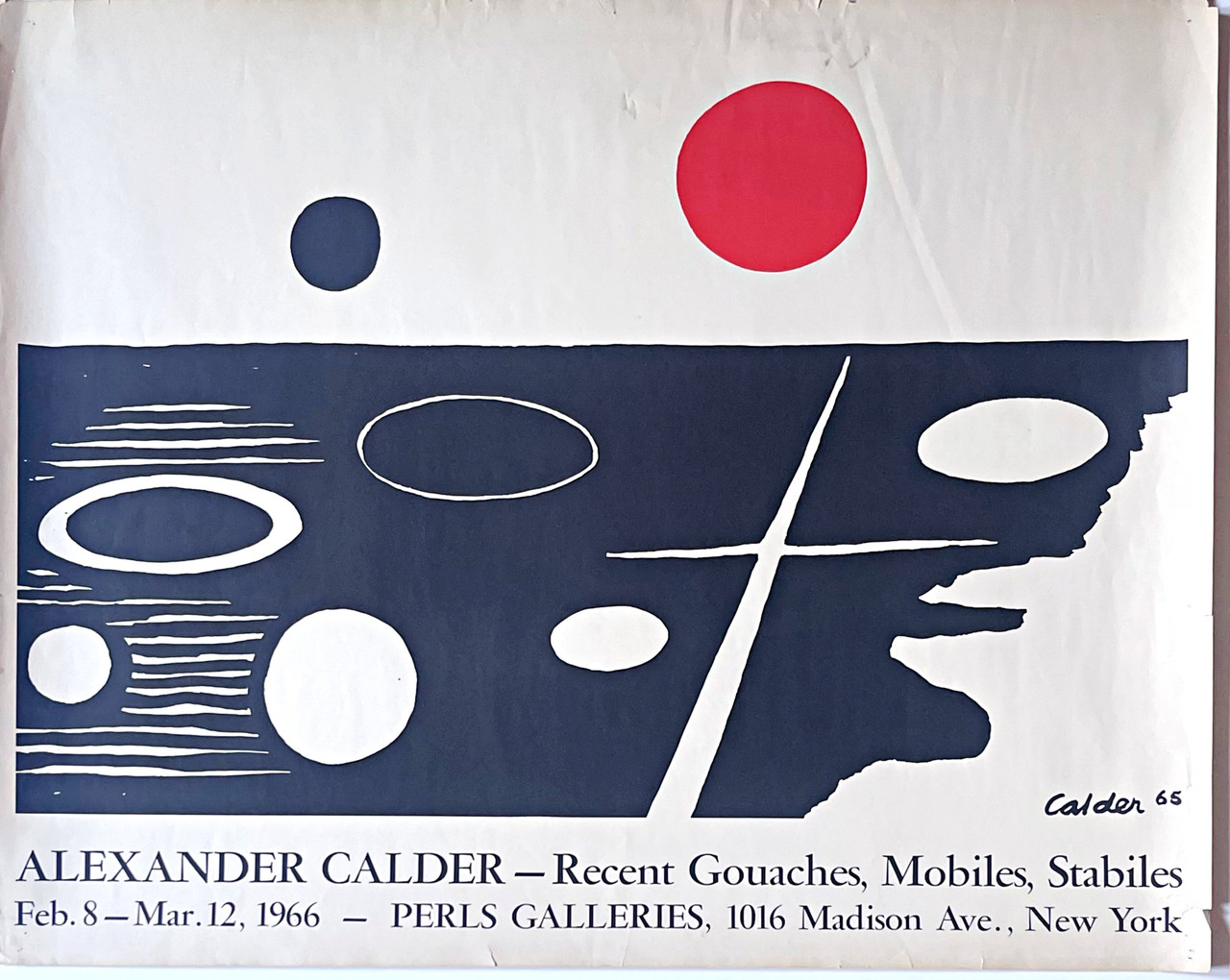
Alexander Calder - 1960s Perls Gallery invitation, 1966
This offset lithograph poster was issued to publicize a 1966 exhibit of recent work by the artist Alexander Calder at the Perls Galleries on 1016 Madison Avenue in New York City entitled "Recent Gouaches, Mobiles, Stabiles". Founded in 1937 by Klaus Perls, Perls Galleries was the primary dealer for Alexander Calder beginning in 1954. As a pivotal figure in the New York art scene, Calder's work bridged the gap between surrealism and abstract expressionism. His contributions are celebrated worldwide, particularly for their playful sophistication and profound influence on public art.
Known for his revolutionary approach to form and space, Calder brought movement into sculpture with his famous mobiles and stabiles, forever altering the landscape of contemporary art. The simplicity of this poster composition belies Calder's ability to transform figures into fluid, organic forms that engage with the forces of nature and the kinetics of motion.
This exhibition in early 1966 shortly appeared shortly after The Guggenheim held a major retrospective of Calder’s work and the same year Calder published his Autobiography With Pictures.
This work has plate (printed) signature and is in vintage condition with some toning, creasing and minor tears to the edges, much of which should frame out. (price reflects condition)
Alexander Calder Biography
Alexander Calder was born on July or August 22, 1898, in Lawnton, Pennsylvania, into a family of artists. In 1919, he received an engineering degree from Stevens Institute of Technology, Hoboken, New Jersey. Calder attended the Art Students League, New York, from 1923 to 1925, studying briefly with Boardman Robinson and John Sloan. As a freelance artist for the National Police Gazette in 1925, he spent two weeks sketching at the circus; his fascination with the subject dates from this time. He also made his first wire sculpture in 1925, and the following year he made several constructions of animals and figures with wire and wood. Calder’s first exhibition of paintings took place in 1926 at the Artist’s Gallery, New York. Later that year, he went to Paris and attended the Académie de la grande chaumière. In Paris, he met Stanley William Hayter, created his famous Cirque Calder, which he began performing in the fall of 1926, and exhibited at the 1927 Salon des Indépendants. The first show of his wire animals and caricature portraits was held at the Weyhe Gallery, New York, in 1928. That same year, he met Joan Miró, who became a lifelong friend. Subsequently, Calder divided his time between France and the United States. In 1929, the Galerie Billiet gave him his first solo show in Paris. He met Frederick Kiesler, Fernand Léger, and Theo van Doesburg and visited Piet Mondrian’s studio in 1930. Around this time, he also encountered James Johnson Sweeney, future director of the Guggenheim Museum, who would become a close friend and supporter. Calder began to experiment with abstract sculpture and in 1931–32 introduced moving parts into his work. These moving sculptures were called “mobiles”; the stationary constructions were to be named “stabiles.” He exhibited with the group Abstraction-Création (Abstraction Creation, 1931–36) in Paris in 1933. In 1943, the Museum of Modern Art, New York, gave him a retrospective.
During the 1950s, Calder traveled widely and executed “gongs” (sound mobiles developed in the 1940s) and “towers” (wall mobiles developed around 1951). He won the Grand Prize for sculpture at the 1952 Venice Biennale. He exhibited, along with other pioneers of Kinetic art including Yaacov Agam and Jean Tinguely, in Le mouvement (Movement) at the Galerie Denise René, Paris, in 1955. Late in the decade, the artist worked extensively with gouache; from this period, he executed numerous major public commissions. In 1964–65, the Guggenheim Museum presented a Calder retrospective. He began the “totems” in 1965 and the “animobiles” in 1969; both are variations on the standing mobile. A Calder exhibition was held at the Whitney Museum of American Art, New York (1976), and the Guggenheim Museum Bilbao (2003). Calder died on November 11, 1976, in New York.
-

-
-
-
-
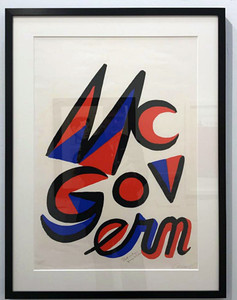
Alexander Calder, McGovern for McGovernment (Signed by BOTH Calder and George McGovern), 1972
CHf0.00Alexander Calder